
Wing Foiling Explained: Wing Power, Foil Lift and Control
Learn how wing foiling combines a hand-held wing with a hydrofoil. Compare it with kitesurfing and windsurfing, and understand the stages of learning.
By ActionSportsHQ Editorial · Published · 5 min read
At a glance
- The hand-held wing interacts with air while the foil interacts with water; their forces must work together.
- A wing is not a kite with long flying lines and is not a windsurf sail fixed to the board.
- Equipment compatibility and an appropriate learning venue matter before briefly lifting the board.
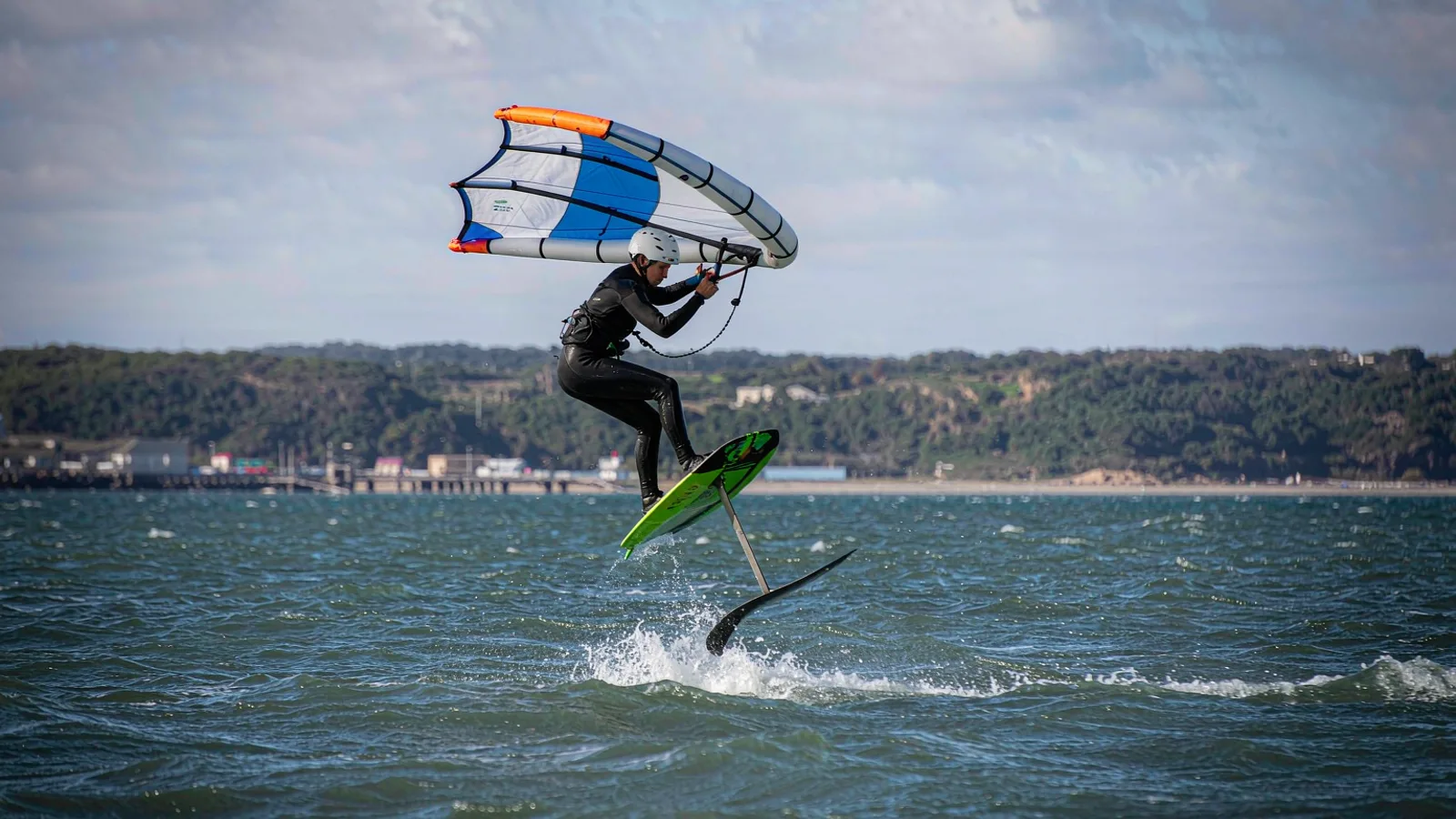
Wing foiling combines a hand-held wing working in air with a hydrofoil working in water. The wing helps drive the board, while the submerged foil can support it above the surface once there is suitable water-relative motion. Learning wing control, board travel and foil height control involves separate tasks rather than one single takeoff trick.
Distinguish the equipment from similar sports
A hand-held wing is not a kite controlled through long flying lines. It is also not a windsurf rig fixed to the board through a mast base. There may still be leashes and other connections, so “no lines” should not be read as “no connection or entanglement questions.”
The board, foil and wing each have their own design and intended use. Learning one wind sport provides experience, but it does not automatically establish competence with all the controls and recovery demands of another.
Air and water provide different forces
Moving the wing changes its orientation to the apparent wind. As the board gains motion relative to the water, the foil can generate enough upward force to support the rider and lift the board. It also generates drag and has handling limits.
Neither a wing-area number nor a foil-area number describes the complete system. The rider, board shape, foil design and conditions all matter. Duotone’s selection guidance distinguishes beginner equipment from arrangements used by highly experienced riders. 1
Pitch makes height control an active task
Board pitch changes the geometry of the foil system. The response depends on the actual mast, wings, board and settings. A generic instruction to place the feet a particular distance apart cannot apply to every setup.
Learn appropriate handling and height-control tasks with a qualified instructor. The RYA’s foiling-management material places learning in an organised environment with suitable activity planning. 2 A brief first flight does not prove that the rider can manage the whole session independently.
The foil changes the venue question
Depth, submerged obstacles, access and separation from other users need attention. A location popular for another water sport is not automatically a suitable learning venue for a foil. The approach and return should be understood before the equipment is used.
Manufacturer safety guidance highlights the foil’s injury potential and suitable protection. 3 Actual leash, flotation and release arrangements require equipment-specific and venue-specific advice. This article does not supply one arrangement for every body of water.
Wing foiling, kitesurfing and windsurfing compared
| Activity | Wind-powered surface | Key equipment distinction |
|---|---|---|
| Wing foiling | A hand-held wing | The rider holds the wing separately from the foil board |
| Kitesurfing | A kite flown on a line/control system | The long-line system and its controls introduce different handling and recovery demands |
| Windsurfing | A sail rig attached through a board joint | The rig-to-board connection is part of the handling system |
The comparison describes the basic systems, not interchangeable safety or leash arrangements. The RYA explicitly distinguishes non-foiling wing learning, first flights and sustained-flight skills. 4 A learner can therefore have useful wing-handling practice without yet having established controlled foiling.
For a simplified force model, lift depends on relative flow, density, area and a coefficient determined by design and orientation. 5 Here the important distinction is between air-relative flow at the hand-held wing and water-relative flow at the submerged foil. The two surfaces cannot be evaluated from one area number or one shoreline wind reading.
Imagine a lesson in which the rider can handle the wing on a stable board but cannot yet maintain a suitable route. Briefly lifting onto a foil would not answer that route-control question. A coach can select a task that separates the difficulty before changing to a more demanding setup.
Read the beginner equipment guide for component selection. Read hydrofoil surfing mechanics for foil parts and pitch. Keeping the learning goal, equipment and venue connected makes a more useful progression than chasing the smallest board in a video.
Choose one learning problem at a time
Early instruction may use equipment or exercises different from the eventual foiling objective. That is a useful way to distinguish wing handling from board and foil control. Equipment changes should solve an identified problem rather than imitate a professional video.
The companion setup guide explains how to record compatibility and manufacturer instructions. A productive progression links a suitable task, current conditions and repeatable control; it does not use a calendar or a small board as evidence that the next stage is required.
Reader questions
What is the difference between wingsurfing and wing foiling?
Wingsurfing can develop hand-held wing control on a board travelling on the water. Wing foiling adds a submerged foil and the task of controlling the board above the surface. The RYA separates these learning stages rather than treating a first flight as complete independence.
Is wing foiling the same as kitesurfing without lines?
No. A hand-held wing and a kite flown through a long-line control system have different equipment, force transmission and recovery tasks. Wing equipment may still use leashes or other connections, so fewer flying lines does not mean no entanglement or release questions.
Sources and scope
Each reference supports the topic stated in its scope note. Worked examples are illustrative unless identified as measured results. Use current local information and the manual for your own equipment alongside appropriate practical instruction.
- Duotone: choosing wing-foiling equipmentManufacturer discussion of equipment selection and beginner suitability.
- RYA: safe management of foiling activityFoiling activity management and instruction context, not a universal personal-equipment setup.
- Duotone: wing-foiling safety measuresFoil injury awareness, protective equipment and beginner board-leash advice.
- RYA: wingsurfing and wingfoiling course pathwayThe distinction between non-foiling wing control, first flights and sustained-flight learning.
- NASA Glenn: lift equationThe simplified relationship among lift, fluid density, speed, area and lift coefficient; not equipment performance certification.
Continue reading
- Beginner Wing-Foil Equipment: Board, Wing and Foil
Choose beginner wing-foil equipment as a complete system. Compare board volume and shape, foil connections, wing handling and second-hand buying checks.
- Hydrofoil Surfing Explained: Lift, Pitch and Foil Parts
Learn how a surf hydrofoil generates lift, what the mast and wings do, and why pitch, water flow and the complete setup matter more than area alone.
- Windsurfing Basics: Sail Forces, Steering and Planing
Understand windsurfing sail forces, board and fin roles, introductory steering and planing. Compare learning stages without relying on a universal speed target.