
BMX Frame Geometry: Top Tube, Reach, Stack and Wheelbase
Read BMX geometry charts by separating top-tube length, frame reach, stack and wheelbase. Compare reference points, missing dimensions and complete-bike setup.
By ActionSportsHQ Editorial · Published · 7 min read
At a glance
- Frame reach and stack are horizontal and vertical coordinates from the bottom bracket to a stated head-tube reference.
- Top-tube length, wheelbase and grip position use different endpoints and should have separate comparison fields.
- A BMX chart may omit reach or stack; retain missing information instead of deriving it from top-tube length alone.
BMX geometry uses measurements with different endpoints. Top-tube length describes front-to-rear frame geometry; frame reach and stack locate a head-tube reference relative to the bottom bracket; wheelbase measures axle spacing. These dimensions describe different relationships, so a longer top tube cannot simply be relabelled as more reach.
A BMX chart may publish top tube, chainstay, angles and bottom-bracket dimensions without supplying reach or stack. The examples below show how to read the actual chart, preserve missing fields and separate frame coordinates from the stem, bars and final hand position.
Define the origin and the endpoint
The bottom bracket houses the crank spindle. Its centre is a useful coordinate origin. Under the common frame-chart convention used here, the other point is the centreline at the top of the head tube. Reach measures the horizontal difference between those points; stack measures the vertical difference.
Canyon’s geometry explanation uses these frame definitions and separately describes measurements to the hands. The reference is a road-bike resource: its coordinate distinction is useful here, while its model-specific positioning advice is outside this BMX comparison. It also defines wheelbase between the wheel hubs. 1
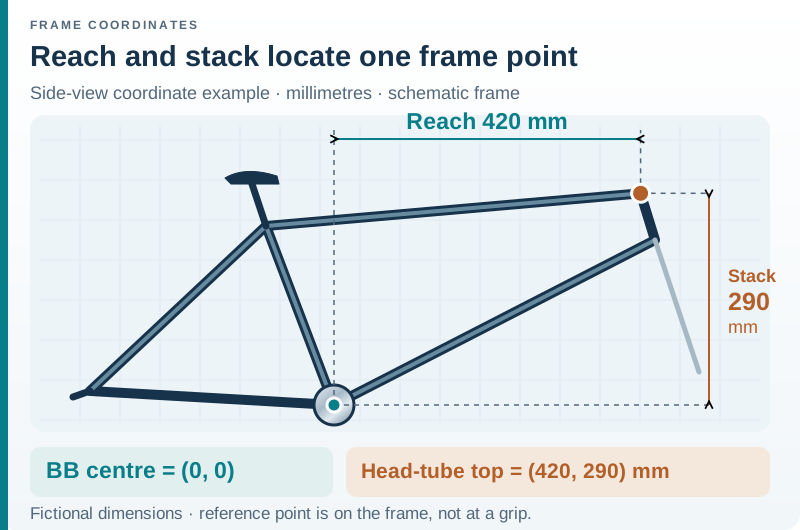
Read the maker’s own diagram before importing a number. A label such as “effective reach” may use a different endpoint. Keep the definition with the value so that a coordinate to the head tube is never silently compared with a coordinate to a grip.
Top-tube length asks a different question
A top-tube measurement relates the front and rear parts of the frame. Frame reach relates the head-tube reference to the bottom bracket. The seat-tube position, angles and the chosen top-tube measurement convention therefore matter when trying to connect them.
Imagine two drawings sharing the same head-tube top and bottom-bracket points. Move the seat-tube junction while leaving those two points fixed. The top-tube length can change even though reach and stack have not. Conversely, a matching top-tube entry does not uniquely identify the other coordinates. This is a geometric thought experiment, not a pair of manufactured frames.
A chart may give actual tube length, a horizontal or effective length, or a model’s named top-tube size. Preserve that wording. Writing “TT” above every value without the diagram can erase a meaningful difference between tables.
Read a real BMX chart without inventing missing fields
WETHEPEOPLE’s PATROL page lists top-tube options of 20.8, 21.15 and 21.5 inches. It separately lists a 13.6–14 inch chainstay range, head-tube and seat-tube angles, bottom-bracket height and standover. That set of entries illustrates how a BMX chart can organise geometry without supplying a frame-reach and frame-stack pair. 2
The practical response is to record what is published, then identify what remains to ask. Do not rename a 21.15-inch top-tube entry “reach” because a comparison spreadsheet has a blank reach column. If a manufacturer provides additional dimensions, copy them with the model year, size and drawing reference.
Units deserve a separate check. One inch equals 25.4 mm, so 21.15 inches converts to 537.21 mm. Those extra decimal places come from conversion, not from a new measurement accurate to a hundredth of a millimetre. Keep the original label beside the converted value.
Use a coordinate comparison to make the difference explicit
These are fictional chart records, not actual BMX models or suggested dimensions:
| Field | Frame A | Frame B | Difference to record |
|---|---|---|---|
| Reach to head-tube top centre | 420 mm | 430 mm | B’s reference is 10 mm farther forward |
| Stack to the same reference | 290 mm | 300 mm | B’s reference is 10 mm higher |
| Stated wheelbase | 990 mm | 1,005 mm | B’s axles are 15 mm farther apart under the stated configuration |
| Top-tube measurement | Not supplied | Not supplied | No comparison established |
| Stem and bar configuration | Not supplied | Not supplied | Hand-position difference unknown |
Putting the two bottom-bracket origins together would place B’s head-tube point 10 mm forward and 10 mm above A’s. The straight-line separation between those points is √(10² + 10²), about 14.1 mm. That diagonal distance is an optional description of the overlay; it is neither frame reach nor frame stack.
The table also shows the value of an honest blank. The two known coordinates do not establish whether the hands move by the same amounts. There is no rider in this calculation, and the wheelbase entries do not determine how either complete bike will feel.
Keep the cockpit in a second layer of the record
The frame ends at its head-tube reference; a headset, stem and handlebar continue the structure toward the hands. A complete setup comparison therefore needs the component arrangement as well as the frame chart.
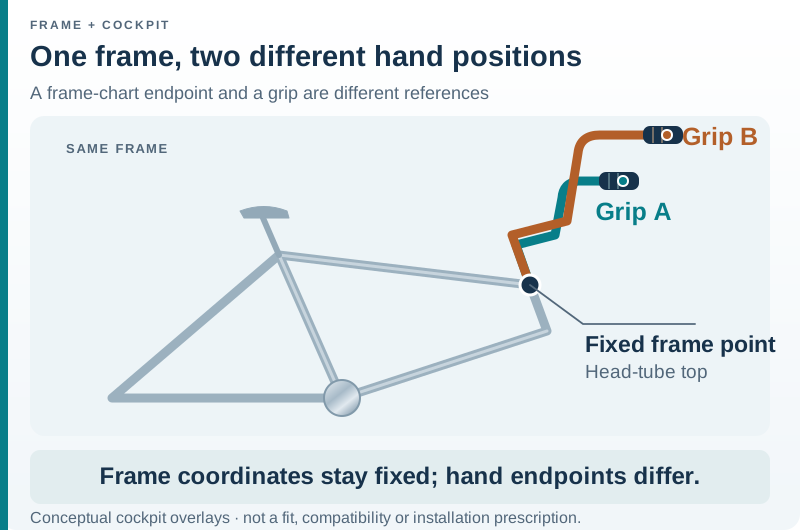
Record stem model and stated extension, bar model and dimensions, and any relevant manufacturer-defined arrangement. Handlebar rise is one entry in that record, not automatically the vertical change of the grip on an assembled bike. Orientation and the other components contribute to the final position.
For a second-hand bike, distinguish the seller’s frame identification from the parts currently installed. A catalogue photograph may show a different bar or fork. The BMX inspection log gives a practical way to preserve unknown identifiers and changed components without treating the original complete-bike specification as current evidence.
Wheelbase describes the assembled axle relationship
Wheelbase locates the front axle relative to the rear axle in the chart’s configuration. It includes geometry beyond the upper frame point. Fork geometry and the rear axle’s position are therefore relevant to understanding which assembly a value describes.
A chainstay range adds another question: where in that range is a published complete-bike measurement taken? Keep a note such as “rear-axle position not stated” until that is resolved. Do not combine the shortest chainstay from one configuration with a wheelbase quoted for another and call the result a single measured bike.
For practical reading, separate three rows: frame coordinates, axle geometry and cockpit components. The bowl-riding explanation concerns a different problem—the connected terrain and movement task. The peg compatibility guide adds component-interface questions that a geometry chart cannot settle.
Leave with a precise supplier question
A useful request is: “For this frame size and year, what are the reach and stack reference points, and what fork and rear-axle position does the wheelbase assume?” Include the diagram you are comparing. A supplier can answer or identify a missing dimension; “is this longer?” leaves the measurement itself unresolved.
Preserve the manufacturer’s units and wording in the final note. That makes a later comparison reproducible even when the bike’s components change. Geometry becomes more useful when each number has a defined origin, endpoint and configuration.
Sources checked 3 November 2026. Coordinate tables, calculations and vector diagrams are original hypothetical editorial examples, not rider-fit or handling tests.
Reader questions
Is headset stack height the same as frame stack?
No. A headset's stack-height specification concerns the headset assembly. Frame stack locates a head-tube reference relative to the bottom bracket. Keep the component specification separate from the frame-chart coordinate.
Is BMX top-tube length the same as frame reach?
No. Top-tube length relates front and rear frame points under the maker's convention. Frame reach is a horizontal coordinate from the bottom bracket to a head-tube reference. A top-tube entry alone cannot supply a missing reach value; ask for the actual dimensioned geometry drawing.
Does changing a stem alter the published frame reach?
It changes the cockpit arrangement, not the frame's published coordinate. Keep a separate record of stem and bar details when comparing hand positions, and follow component compatibility instructions.
Sources and scope
Each reference supports the topic stated in its scope note. Worked examples are illustrative unless identified as measured results. Use current local information and the manual for your own equipment alongside appropriate practical instruction.
- Canyon: road-bike geometry definitionsGeneric frame reach, stack and wheelbase reference points, and the distinction between frame and hand-position measurements; road-bike fit advice is not transferred to BMX.
- WETHEPEOPLE: PATROL frame specifications and geometryA real BMX chart listing top-tube options, chainstay range, head-tube and seat-tube angles, bottom-bracket height and standover.
Continue reading
- BMX Pre-Ride Check: Wheels, Brakes and Bike Inspection
Organise a BMX pre-ride check and write a useful fault report. Download a reusable inspection log with clearly labelled fictional examples for a mechanic.
- BMX Bowl Riding: How Pumping and Transitions Work
Understand BMX bowl pumping, transition shape and line choice. Compare banks, curved walls and coping before choosing a suitable coached session.
- BMX Grinds Explained: Pegs, Contact and Compatibility
Understand BMX grind contacts, peg cores and sleeves, axle compatibility, and the approach and exit questions that define a complete street line.