
Wakeboarding Basics: Boat vs Cable and Board Control
Compare boat and cable wakeboarding, understand tow tension and board edges, and prepare questions about equipment, flotation and the operator's briefing.
By ActionSportsHQ Editorial · Published · 5 min read
At a glance
- The tow provides a force while the board’s contact with water controls its path.
- Boat and cable environments have different operating arrangements and should not share a generic SOP.
- Flotation, communication and recovery arrangements must fit the actual venue and local rules.
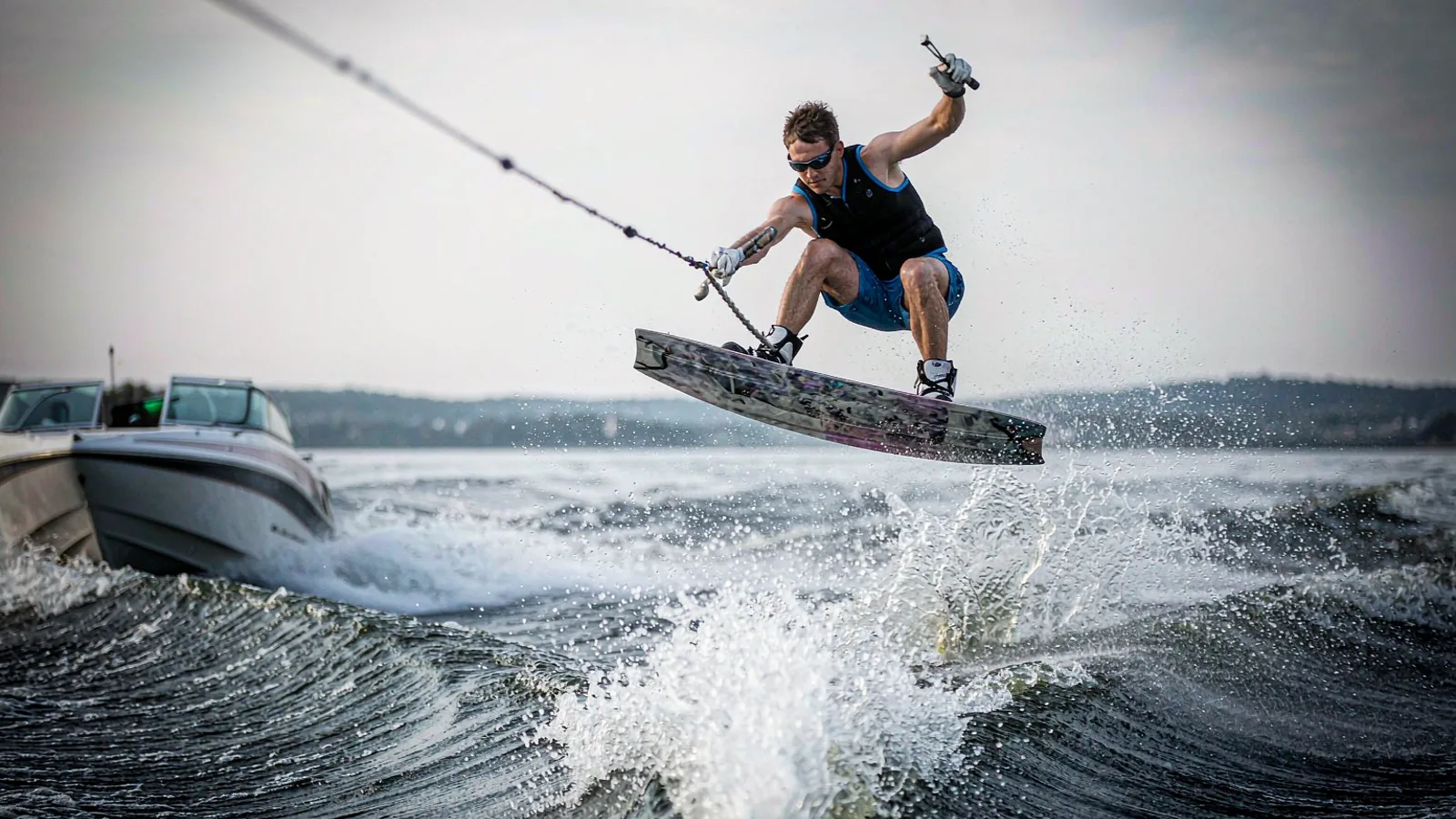
Wakeboarding pulls a rider across water using a boat or cable tow. The tow supplies force while the board’s contact with water influences direction and support. Boat and cable sessions share that broad idea, but their start arrangements, routes, communication and recovery procedures differ and require the relevant operator’s briefing.
The tow and the board form one interaction
The line transmits a force from the towing system. The board also experiences forces from its contact with the water. Changing its direction or edge affects that interaction and the rider’s path relative to the tow.
This is not the same as following a fixed dry-land line. The water surface, towing arrangement and rider movement change through a run. A mechanics explanation can identify those forces, but it does not prescribe a universal rope length, towing speed or stance for every rider.
A wake is not a required first goal
Crossing or jumping a wake adds demands beyond simply starting, travelling under control and finishing a run. The useful foundation is a predictable response to the tow and water within the instructor’s selected exercise.
Do not use an online jump sequence as an introduction to the activity. The takeoff, airborne phase and landing depend on the actual task. A qualified coach should choose a progression suited to current control and explain how to end the exercise.
Boat and cable sessions have different contexts
On a boat, the operator and crew organise the towing route, communication and rider recovery. At a cable park, the facility has its own starting, stopping and obstacle-use procedures. Follow the relevant briefing instead of carrying a signal or recovery rule from one environment into another.
Check local laws and facility rules. The US Coast Guard’s boating information explains that federal and state requirements can differ; it is not a legal rule for every country or water body. 2 The boat, crew and venue must be appropriate for the activity being conducted.
Boat versus cable: compare the session before the tricks
British Water Ski and Wakeboard identifies boat and cable towing as different participation contexts and provides a structured wake-sport learning pathway. 3 Choose the actual session type before assuming what a first lesson will involve.
| Question | Boat session | Cable session |
|---|---|---|
| What provides the tow? | A boat with a crew and operating route | A facility’s cable system |
| What shapes the run? | The boat route, water and any wake task selected | The system layout and operator’s selected exercise |
| What briefing is needed? | Crew communication, starting, finishing and recovery | Facility start/stop, route and recovery arrangements |
| Are obstacles part of the lesson? | Only where the actual lesson plan introduces them | A cable park’s features are not automatic beginner tasks |
The table is a planning comparison, not a set of operating instructions. Ask the provider what equipment is included and which rules apply to the particular session. Do not carry a hand signal learned behind one boat into a cable session without checking its meaning.
The board’s edge changes the interaction with water while the tow continues to pull. A force explanation helps separate the two influences, but cannot choose a rope length, speed or movement for a learner. If the goal is a controlled start and finish, adding a jump changes the learning task.
For a useful first-session note, record the method booked, the equipment fitted, the communication briefed and the skill the coach wants demonstrated. The wing-foil equipment article offers a comparison of how a different board sport organizes compatibility; it does not supply wakeboard settings. The surf forecast article can help distinguish waves and swell, while inland venue conditions still require their own assessment.
Choose flotation for the intended use
An impact vest is not automatically an approved life jacket. Check the product’s intended use, approval, fit and the operator’s requirements. The US Coast Guard’s guide discusses activity-appropriate flotation, including towed water sports. 1
Footwear or bindings, the board and tow equipment have their own fitting and inspection requirements. Do not assume a tight fit is correct or adjust an unfamiliar system without the instructor’s guidance.
Plan how the run ends
Ask about communication, stopping and recovery before starting. Keep clear of operating machinery and follow the operator’s directions during recovery. These are practical procedures to learn at the venue, not actions to improvise from a short article.
A useful first-session goal is understanding the briefing and completing an appropriate exercise with control. More speed, a wake jump or an obstacle is not automatically the next step. Progress should remain connected to the actual environment and the rider’s demonstrated ability.
Reader questions
Is cable wakeboarding the same as riding behind a boat?
Both tow a rider over water, but the operating layout, starting, communication and recovery arrangements differ. Follow the briefing for the actual boat or cable system, and do not assume features or signals transfer unchanged between them.
Is an impact vest automatically a suitable life jacket for wakeboarding?
No. Read the product's intended use, approval, fit information and the operator's requirements. Flotation requirements depend on the activity and jurisdiction, and an impact-protection label alone does not establish the required buoyancy or approval.
Sources and scope
Each reference supports the topic stated in its scope note. Worked examples are illustrative unless identified as measured results. Use current local information and the manual for your own equipment alongside appropriate practical instruction.
- US Coast Guard: choosing a life jacketActivity-appropriate flotation, including towed water sports.
- US Coast Guard: boating safety questionsFederal versus local boating requirements and flotation context.
- British Water Ski and Wakeboard: participation and learning pathwaysBoat and cable towing as distinct activity contexts and structured wake-sport learning.
Continue reading
- How to Read a Surf Forecast: Height, Period and Direction
Decode surf forecast labels with worked component comparisons. Separate combined seas, swell period and direction, then keep a record using the Swell Component Lab.
- Beginner Wing-Foil Equipment: Board, Wing and Foil
Choose beginner wing-foil equipment as a complete system. Compare board volume and shape, foil connections, wing handling and second-hand buying checks.