
Skateboard Wheels: Diameter, Durometer and Contact Patch
Compare skateboard and longboard wheel diameter, durometer, contact-patch width and profile. Read labels accurately and check what each specification leaves out.
By ActionSportsHQ Editorial · Published · 6 min read
At a glance
- Diameter, hardness and tread geometry describe separate properties; compare all three before interpreting a wheel label.
- A manufacturer's contact-patch width is different from a measured area of contact under a particular rider.
- Record the exact skating system and component compatibility before transferring a specification between sports.
Wheel diameter describes outside size in millimetres; durometer is a hardness designation on a stated scale; profile and contact-patch width describe tread geometry. A label such as “70 mm / 80A / rounded lip” combines independent properties. None of those entries is an overall performance score.
For skateboard and longboard comparisons, keep size, hardness and shape in separate fields. First identify the system: board trucks, inline frames and quad-skate assemblies do not share one wheel-fitting specification. The examples below explain product labels without transferring a setup between sports.
Separate the units before interpreting the numbers
Rollerblade’s wheel explanation distinguishes size in millimetres, hardness on the Shore A scale and several profile shapes. Those terms apply to its inline discussion; they are useful vocabulary, rather than permission to fit an inline wheel to a skateboard. 1
Use separate columns for diameter, overall width, the maker’s contact-patch width, hardness including its scale letter, profile and core position. An entry that reads only “80” has lost information: it could mean an 80 mm diameter or an 80A designation. Copy the complete label.
A short listing may omit a field. Mark it “not stated” and look for the manufacturer’s fuller specification. In particular, a photograph taken at an angle is a poor substitute for an actual width entry. It can help identify the style of an edge, but perspective prevents a reliable measurement.
Diameter changes radius and circumference in different ways
Diameter is the outside distance across the wheel through its centre. Radius is half that distance. These simple relationships help check a proposed size change without pretending to predict the ride.
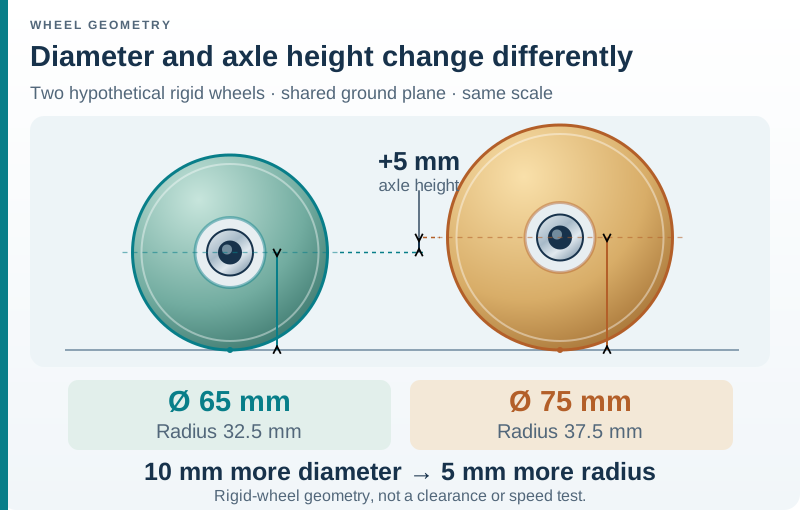
Consider two hypothetical rigid wheels, 65 mm and 75 mm in diameter, placed on the same level surface. Their centres sit 32.5 mm and 37.5 mm above it. The difference in nominal axle height is 5 mm. If a listing says the larger diameter adds 10 mm of axle height, it has confused diameter with radius.
Circumference is π times diameter. The larger example covers 75/65, or about 1.154 times the distance per revolution under ideal rolling. That is roughly 15.4% more distance per turn of the wheel, not a prediction that a rider will travel 15.4% faster. Rotation rate, rolling losses and the rest of the system have not been held constant in a ride.
Clearance is a separate drawing problem. On a board, the wheel approaches different parts of the deck as the truck turns. A static vertical gap cannot describe that entire movement. On an inline skate, the frame and wheel arrangement set different limits. Record the permitted diameter for the actual assembly instead of turning the 5 mm arithmetic into an installation recommendation.
Read hardness as a material label, then inspect the shape
A hardness number does not describe the outline of a wheel. To see the missing information, hold the number fixed in an imaginary comparison and change the tread shape instead.
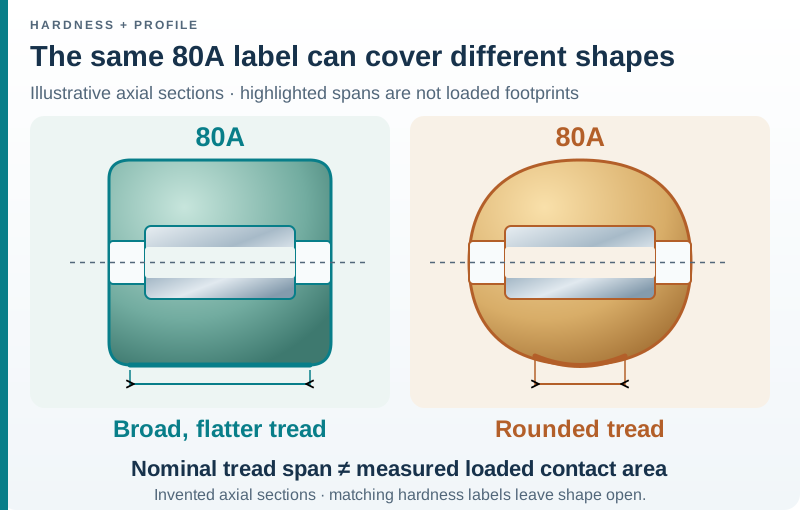
The left outline has a broad, relatively flat tread. The right outline curves more strongly toward the edges. Both carry the fictional label 80A. The number alone cannot reveal which outline a product uses, nor the formulation, core design or surface preparation. A useful comparison therefore keeps a profile drawing or a straight-on product view beside the numerical fields.
This also clarifies a common naming trap: a rounded lip on a longboard wheel and a rounded profile in an inline catalogue need not describe the same complete geometry. Check what part of the cross-section the manufacturer is discussing.
Contact-patch width is not a contact-area measurement
Orangatang publishes overall width and contact-patch width as separate fields. For example, its guide lists the 70 mm Stimulus as 49 mm wide with a 42 mm contact patch, whereas the 70 mm 4President has both fields at 53 mm. Their listed lip shapes also differ. 2
The useful inference is specific: equal diameter does not establish equal tread width or edge geometry. Subtracting the two width entries can identify that some of the overall width lies outside the stated tread span. It does not reveal the pressure distribution beneath a rider.
A catalogue width is a length, usually in millimetres. A physical footprint is an area and shape under a particular load and surface condition. Multiplying the stated width by an imagined contact length would manufacture an area that was never measured. Keep that missing measurement visible rather than converting a product field into a friction estimate.
Work through a fictional two-wheel listing
The following entries are invented specification-reading examples, not existing products or test results.
| Field | Listing A | Listing B | What the comparison establishes |
|---|---|---|---|
| Diameter | 70 mm | 70 mm | Equal nominal outside size |
| Hardness label | 80A | 80A | Matching stated hardness designation |
| Overall width | 50 mm | 46 mm | Different overall widths |
| Stated tread width | 48 mm | 36 mm | Different nominal tread spans |
| Edge | Squarer lip | Rounded lip | Different edge descriptions |
| Intended use | Grip-oriented carving | Freeride slides | Different stated design objectives |
It would be a mistake to describe this as an experiment proving that a 12 mm tread-width difference causes a particular handling change. Width, edge shape and design objective all changed together. The table explains the products’ descriptions; it does not isolate a cause.
Landyachtz explicitly distinguishes the sliding objectives of its freeride wheels from the grip objectives of its race wheels. 3 Use intended-use information to frame the comparison, then keep any performance claim attached to its manufacturer. Our freeride wheel guide discusses rolling-to-sliding transitions in more detail.
Finish with a comparison note someone else can read
A useful note names the current wheel, the proposed wheel, the compatible assembly and the question the change is meant to address. For example: “Compare two permitted diameters for this deck and truck arrangement; confirm clearance separately; retain the exact width, profile and hardness entries.” That is more informative than “buy something softer.”
For inline equipment, use the flat versus anti-rocker explanation to keep wheel positions and frame design in view. For downhill objectives, the course-planning guide adds a different set of questions. A complete product comparison describes the equipment accurately before it tries to explain a riding outcome.
Sources checked 3 November 2026. All diagrams and fictional comparisons are original editorial explanations, not independent wheel tests.
Reader questions
Is 80A a size or a hardness measurement?
It is a hardness designation on the A scale. Diameter and width normally use millimetres. Keep the scale letter when copying a hardness number; a bare 80 could be confused with an 80 mm diameter.
Can wear change the useful wheel specification?
Yes. The advertised diameter and lip shape describe the product as sold. A used wheel can have a smaller, uneven diameter or a changed edge. Record present condition separately from the original specification.
Does fitting the bearing prove that a wheel fits the setup?
No. Bearing fit is one interface. Wheel width, axle and spacer arrangements, frame or truck clearance, and the approved wheel layout still need to match the actual components.
Sources and scope
Each reference supports the topic stated in its scope note. Worked examples are illustrative unless identified as measured results. Use current local information and the manual for your own equipment alongside appropriate practical instruction.
- Rollerblade: wheel size, Shore A hardness and profileInline-wheel terminology, the Shore A hardness scale and different profile families; its selection advice concerns inline systems.
- Orangatang: longboard wheel buyer guideSeparate diameter, width, contact-patch, lip, hub and hardness specifications in one manufacturer's longboard range.
- Landyachtz: skateboard wheels explainedManufacturer distinction between freeride sliding objectives and race-wheel grip objectives; not independent comparative testing.
Continue reading
- Longboard Freeride: Slide Wheels, Grip and Setup
Compare longboard freeride wheel lips, contact patches and durometer. Understand slide release, grip recovery and how to evaluate a complete setup.
- Downhill Longboarding: Speed, Grip and Course Planning
Understand downhill longboarding speed, kinetic energy, aerodynamic drag and wheel grip, with a worked comparison and questions for a controlled course.
- Aggressive Inline Skates: Flat vs Anti-Rocker Setups
Compare flat and anti-rocker aggressive skate setups, understand soul plates and H-blocks, and check frame compatibility before practising grinds.