
Hydrofoil Surfing Explained: Lift, Pitch and Foil Parts
Learn how a surf hydrofoil generates lift, what the mast and wings do, and why pitch, water flow and the complete setup matter more than area alone.
By ActionSportsHQ Editorial · Published · 6 min read

At a glance
- A foil generates forces from its motion relative to water; it does not need an engine to do so.
- Pitch changes affect the foil’s orientation and height, but there is no universal foot position for every system.
- Depth, other users and equipment compatibility belong in the lesson plan before attempting to foil.
Hydrofoil surfing uses submerged wings to support a board above the water as the foil moves through it. The front wing, stabiliser, mast and their connections form a system. Waves or another appropriate source supply motion; the foil converts that water-relative motion into forces rather than producing propulsion by itself.
Trace the parts from board to submerged wings
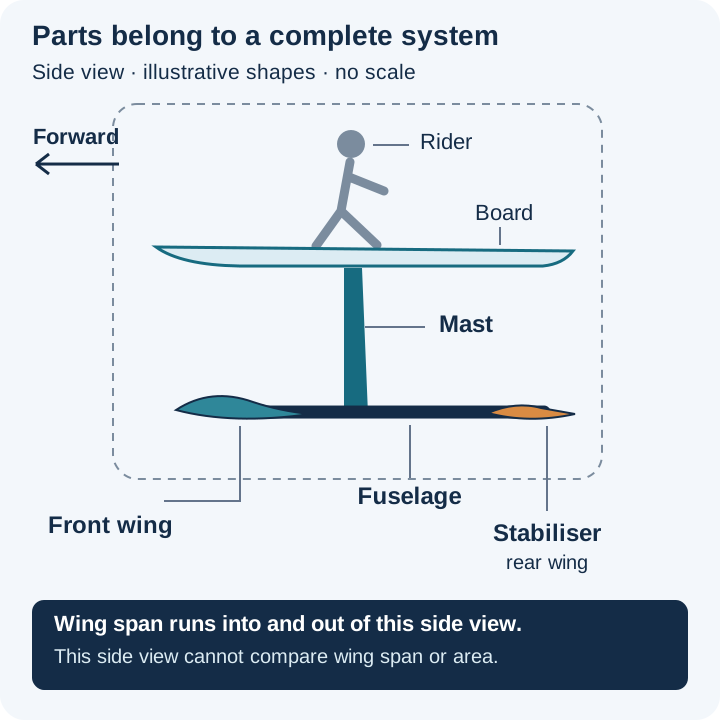
Follow the connection chain in the drawing: board interface, mast, fuselage, then the two wings. This is a way to identify an assembly, not a universal bolt arrangement. Some products integrate connections or components that are separate in this drawing. 5
The side view also exposes a comparison trap. The front wing looks like a short section here, because its span runs into and out of the picture. Two product side photographs can look almost identical while hiding different planforms. To compare area and span, use the manufacturer’s dimensions and a plan view; do not measure either from this schematic.
Keep two meanings of “system” separate when making notes. A foil assembly identifies the submerged components and their connections. The complete riding system adds the board and rider. A wing-area number belongs to one component; rider mass and board choice describe a different part of the problem. A useful comparison needs both records.
Lift comes with drag and changing conditions
The forces on a foil depend on its shape, orientation, water flow and speed relative to the water. A simple description of lift does not establish a minimum takeoff speed for every wing. Drag is also part of the system, and the rider still needs a source of motion.
Do not compare foils using surface area alone. Shape, section, stabiliser and the complete assembly affect behaviour. A wing designed for one task may not be suitable for another just because its dimensions look similar.
Pitch links board movement to foil orientation
Pitch is rotation about the side-to-side axis: the nose and tail move relative to one another. That motion changes the geometry of the foil system and can influence the balance of forces and riding height. The response depends on the actual board, mast, wings and settings.
This does not imply one correct stance measurement for every rider. A qualified instructor can explain the particular equipment and select exercises that develop controlled height changes. A generic instruction to lean a fixed amount is not a reliable substitute.
Identify what each foil component contributes
| Component or measurement | What it identifies | What to check in the actual system |
|---|---|---|
| Front wing | Main submerged lifting surface | Shape, profile and intended use as well as area |
| Stabiliser or rear wing | Another surface influencing system balance | Approved pairing and specified settings |
| Fuselage | Connection and spacing between surfaces where used | Compatible interfaces and assembly |
| Mast | Connection between board and submerged assembly | Length, stiffness and venue clearance |
| Aspect ratio | Relationship between span and area | The actual design, rather than a universal skill-level label |
Duotone describes foil design using several of these parameters together. 5 A part sold under a similar name in another range is not thereby compatible. Read the component identifiers and connection instructions, including the board interface.
The simplified lift relationship includes fluid density, speed, area and a lift coefficient. 4 Its value here is showing why area alone cannot identify takeoff behaviour. The coefficient changes with design and orientation; an aircraft example is not a surf-foil performance chart.
A relative comparison, without a takeoff-speed claim
Write the simplified relationship as lift proportional to area × speed², while holding density and lift coefficient constant. 4 The following is our arithmetic example using relative quantities, not measured foil performance:
| Model case | Relative area | Relative water speed | Calculated relative lift |
|---|---|---|---|
| Reference | 1.00 | 1.00 | 1.00 |
| Area changed alone | 1.20 | 1.00 | 1.20 |
| Speed changed alone | 1.00 | 1.20 | 1.44 |
The third result is 1.20 × 1.20, rather than a prediction that a particular rider will lift at a particular speed. We fixed the coefficient to isolate one mathematical difference; a real change of foil or orientation does not preserve that assumption automatically. The practical lesson for reading specifications is precise: an area percentage and a speed percentage are not interchangeable descriptions of lift. Neither supplies the missing handling and compatibility information.
The wing-foil equipment guide develops that compatibility record. The surf forecast guide addresses the approaching water conditions. Neither a suitable-looking wing nor a promising forecast replaces the instructor’s assessment of depth, access and separation.
The learning space needs more than a wave
A foil introduces submerged components and clearance requirements. Assess depth, obstacles, access and the presence of other water users with the instructor and venue. The RYA’s activity-management guidance treats foiling as an activity requiring an appropriate learning and safety arrangement. 1
Follow local surfing rules and warnings as well. RNLI’s surfing guidance is useful for the beach context but does not certify a location for foiling. 2 A popular conventional surfing area may be unsuitable for a learner with a foil.
Match the system and its protection
Use approved connections and the actual assembly instructions. Inspect damage and fasteners before use, particularly after an impact. Similar-looking foil parts are not necessarily compatible.
The foil can injure a rider or someone nearby. Manufacturer safety guidance highlights that hazard and suitable protection. 3 Fall responses and recovery should be learned for the actual activity and equipment rather than inferred from a cover image or a universal “jump this way” instruction.
Measure learning by control
Keep a lesson task specific and appropriate to the environment. Recognising changing depth, maintaining separation and returning under instruction are as important as briefly lifting the board. Longer flights or smaller equipment are not automatic next steps. The useful progression is repeatable control with an understood way to end the exercise.
Reader questions
How can a hydrofoil lift a surfboard without a motor?
The foil generates forces as it moves relative to water. Motion can come from a wave, tow or another appropriate source, depending on the activity. The foil still creates drag and requires energy input; it is not an engine or a source of free motion.
Does a bigger front wing always make a foil easier?
Area is only one variable. Profile, span, stabiliser, mast, board, rider and conditions affect the complete task. Compare intended use and compatible components with an instructor rather than selecting from area alone.
Sources and scope
Each reference supports the topic stated in its scope note. Worked examples are illustrative unless identified as measured results. Use current local information and the manual for your own equipment alongside appropriate practical instruction.
- RYA: safe management of foiling activityFoiling activity management and instruction context, not a universal personal-equipment setup.
- RNLI: surfing safetyLocal beach assessment, surfing etiquette and safety considerations.
- Duotone: wing-foiling safety measuresFoil injury awareness, protective equipment and beginner board-leash advice.
- NASA Glenn: lift equationThe simplified relationship among lift, fluid density, speed, area and lift coefficient; not equipment performance certification.
- Duotone: foil design parametersManufacturer discussion of front wings, aspect ratio, mast and fuselage geometry; published sizes are not universal prescriptions.
Continue reading
- How to Read a Surf Forecast: Height, Period and Direction
Decode surf forecast labels with worked component comparisons. Separate combined seas, swell period and direction, then keep a record using the Swell Component Lab.
- Beginner Wing-Foil Equipment: Board, Wing and Foil
Choose beginner wing-foil equipment as a complete system. Compare board volume and shape, foil connections, wing handling and second-hand buying checks.
- Wing Foiling Explained: Wing Power, Foil Lift and Control
Learn how wing foiling combines a hand-held wing with a hydrofoil. Compare it with kitesurfing and windsurfing, and understand the stages of learning.