
Whitewater River Grades: Classes, Flow and Consequences
Understand whitewater river grades and Class I–V descriptions. Compare a rapid rating with flow, continuity, access and consequences when planning a trip.
By ActionSportsHQ Editorial · Published · 6 min read
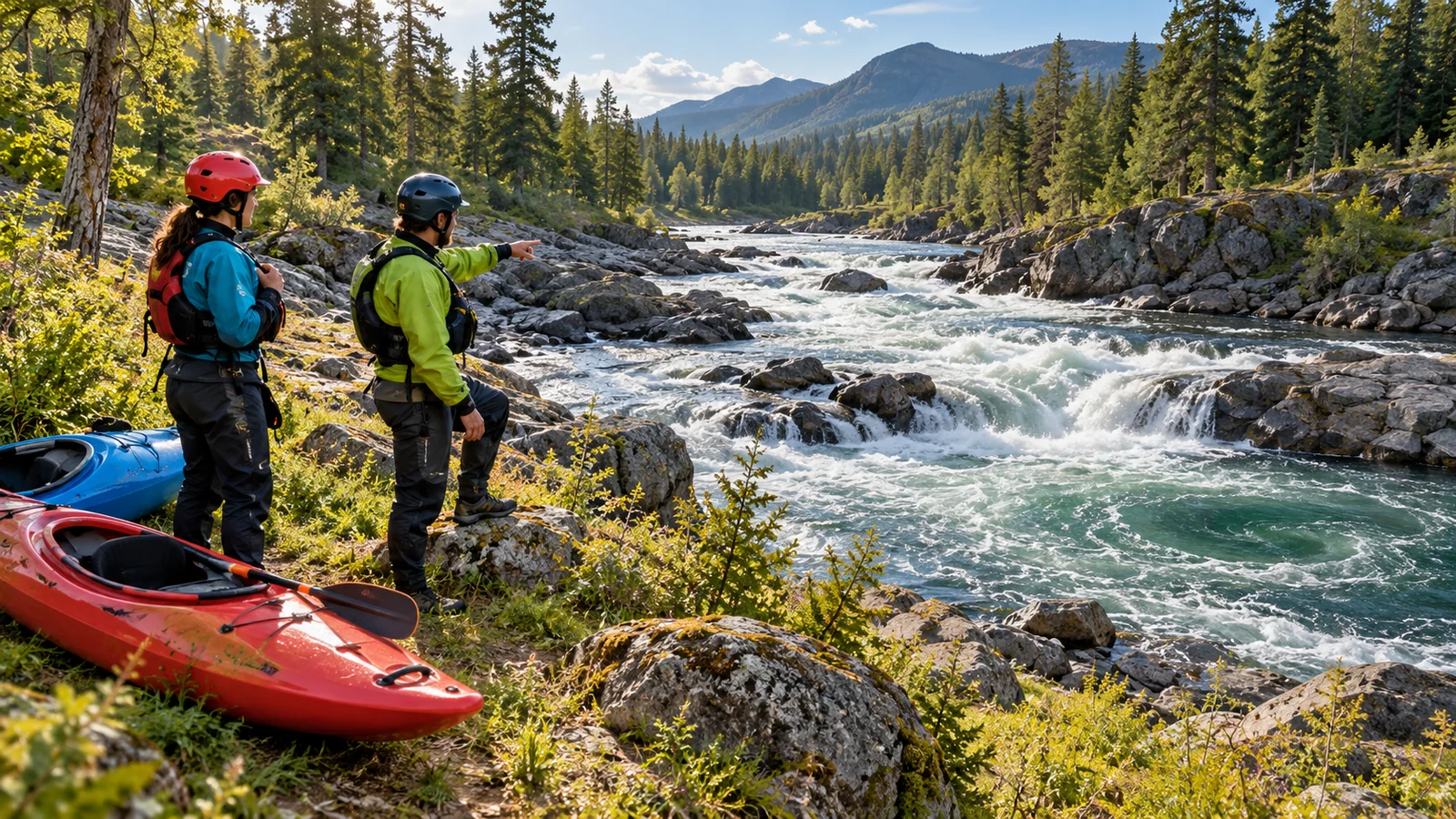
At a glance
- A river grade summarises difficulty; it is not a guarantee of safety or a complete description of consequences.
- Flow, new wood, cold water, remoteness and continuity can change the demands of the same run.
- Use current local information and a trained group rather than a calendar-based progression to a harder class.
Whitewater river grades summarise the difficulty of a rapid or run under a stated convention and conditions. Read the class alongside the description, relevant gauge, current flow, continuity and consequences. A grade helps organise information; it does not certify that a route suits a particular paddler or group.
American Whitewater’s revised 2024 summary explicitly describes the scale as approximate and says it does not replace first-hand descriptions or other river information. Use that limitation as the starting point for trip planning, not as a footnote after selecting an objective. 1
Understand what the class is summarising
The following short descriptions summarise the Class 1–5 entries in American Whitewater’s 2024 overview. They are orientation labels, not a complete course in recognising suitable rapids. Other guides may use Roman numerals, additional subdivisions or older descriptions, so check the system and edition attached to a rating.
| Class in the 2024 overview | Broad skill context |
|---|---|
| 1 | Beginner: simple waves and riffles |
| 2 | Novice: some manoeuvring required |
| 3 | Intermediate: larger features and skilled manoeuvring |
| 4 | Advanced: powerful rapids and precise manoeuvring |
| 5 | Expert: very difficult, demanding water near navigational limits |
The words “beginner” and “novice” describe the scale’s skill context. They do not say an untrained person can safely enter any river carrying that number. Cold water, an obstruction or an inaccessible bank can matter greatly even where the paddling moves are straightforward.
Ask whether the rating is for one rapid or the run
One difficult rapid with a recovery pool and a practical portage is different from sustained difficult water with few places to stop. A whole-run description may include a range, a hardest feature or a general class. Read the accompanying guide rather than guessing which convention was used.
Identify how the route begins and ends, where the difficult sections occur and whether the group can leave before reaching them. A rating that does not describe the approach to a rapid cannot tell you whether scouting from shore will be convenient.
Think about fatigue too. A group capable of one demanding manoeuvre may not be capable of repeating comparable decisions throughout a long run. Continuous water can reduce the time available to regroup and communicate.
Flow is part of the description
Use the gauge or flow reference named by the local guide, together with its units and timing. A water-level reading from a different gauge is not automatically comparable. The rating may describe a familiar range of flows rather than every possible level.
Higher flow can alter features, reduce eddies and change consequences; lower flow can expose obstacles and create different difficulties. It is not reliable to assume either “more water means easier” or “less water means safer.” The direction of change is specific to the reach and feature.
Check recent local reports and current information about obstructions or access. A past successful trip does not establish that the river remains unchanged after storms, tree falls or other events.
Separate paddling difficulty from consequences
Ask what happens if someone fails to make the intended line. The issue is not only whether a move is technically difficult, but whether a swimmer or loose craft would enter another hazard. Consider the group’s actual ability to stop, scout and organise appropriate safety in that environment.
River hazards can include wood, undercut features and hydraulics. They require trained recognition and appropriate decisions; a low grade is not proof of their absence. American Whitewater’s Safety Code discusses planning and hazards in a wider context than the class label. 2
No single gradient percentage determines river class. The old idea of converting slope directly into a difficulty table leaves out the shapes and arrangement of features, the water level and the consequences of errors.
Assess the group, not its most confident member
A route should be appropriate for the actual group and its least prepared participant, including people who will help if something goes wrong. Compare current skills, recent practice, communication and relevant rescue training, not just the hardest run someone has previously completed.
A reliable roll is a valuable kayak skill, but it does not make swimming unnecessary in every situation. A paddler who can roll in a pool may face different conditions in moving water. Conversely, a roll by itself does not provide the judgment needed to assess a particular hazard.
Avoid fixed progression schedules such as “Class V by week twelve.” Time alone cannot establish competence, and adding harder water is not an obligation of a training season. A qualified instructor and suitable local group can help assess readiness for a particular objective.
Example: the same class, two different route problems
Imagine two runs with the same general class. Run A includes separated rapids with described stopping opportunities and established access. Run B has sustained water, limited exits and a difficult section far from assistance. The shared grade does not erase the difference in continuity, fatigue or the consequences of an error. This is a fictional comparison, not an assessment of named rivers.
The next question is whether both descriptions refer to comparable flow conditions. A gauge height is tied to its measurement site and reference; the same height number at another gauge does not imply the same water volume or difficulty. A discharge reading likewise needs its units, location and time. Keep those labels in the trip note.
Older guides may show Class VI or finer subdivisions. This article’s short table explicitly follows the five-class presentation in American Whitewater’s revised 2024 overview, rather than claiming every edition uses identical labels. 1 When comparing guidebooks, first identify the convention and what section is being rated.
The whitewater kayaking guide explains why feature names and individual skills are only part of preparation. Connect the route description to the whole group’s recent capability and suitable instruction, including a workable alternative if the information or conditions no longer fit.
Build a route decision from several sources
| Planning question | Information to obtain |
|---|---|
| What is rated? | The reach, individual features and the rating convention |
| Under what conditions? | Relevant gauge, current flow and recent changes |
| What if the line fails? | Consequences, stopping places and appropriate safety arrangements |
| Who is on the trip? | Current skills, equipment, communication and training |
| Can we change the plan? | Portages, exits, access and a different objective |
This table organises a discussion rather than scoring a river as safe. If the information is missing or the group cannot evaluate it, choose a more suitable outing or seek instruction. A grade is the beginning of a description; it should never be the final reason to put on the river.
A gauge adds measurements rather than a replacement river grade. The river stage and discharge guide shows why a level in metres, a flow in cubic metres per second and a station-specific rating curve cannot be substituted for one another.
Reader questions
What do Class I, II, III, IV and V mean in whitewater?
They express increasing broad difficulty in the five-class overview discussed here, from relatively simple water to expert, demanding rapids. Read the full description and edition. The class alone omits current flow, obstructions, continuity, access and the group's ability to manage consequences.
Can river gradient or gauge height determine the class by itself?
No. Feature shape, flow, continuity and consequences also matter. Gauge height belongs to a particular gauge and reference, so equal numbers at different sites are not equivalent. Use the reach's actual description and current local information.
Sources and scope
Each reference supports the topic stated in its scope note. Worked examples are illustrative unless identified as measured results. Use current local information and the manual for your own equipment alongside appropriate practical instruction.
- American Whitewater: International Scale of River DifficultyThe Class 1–5 overview in the revised 2024 summary and the limits of interpreting a grade.
- American Whitewater: Safety Code, revised 2024Planning, river hazards and swimming context; this is not a rescue course.
Continue reading
- River Gauge Stage vs Discharge: Units and Rating Curves
Understand river stage versus discharge, gauge-height units and station rating curves. Use worked examples to keep datum, location and time with each reading.
- Whitewater Kayaking Basics: Eddies, Holes and Skills
Understand whitewater kayaking eddies, hydraulics and river grades. Separate flow features, boat-control skills and swimming context before choosing a run.
- Mountain Layering System: Base, Midlayer and Shell
Plan clothing for ascent, stops and the return. Use a downloadable layering field log and a fictional worked record to separate garment, fit and packing problems.
- How to Read a Surf Forecast: Height, Period and Direction
Decode surf forecast labels with worked component comparisons. Separate combined seas, swell period and direction, then keep a record using the Swell Component Lab.