
BMX Grinds Explained: Pegs, Contact and Compatibility
Understand BMX grind contacts, peg cores and sleeves, axle compatibility, and the approach and exit questions that define a complete street line.
By ActionSportsHQ Editorial · Published · 4 min read
At a glance
- Pegs and hub attachments must be approved for the actual bike; appearance alone does not establish compatibility.
- A grind changes the bike’s support and sliding contact, so the approach and exit are separate learning tasks.
- Use permitted obstacles and coached practice rather than a public ledge chosen only for its shape.
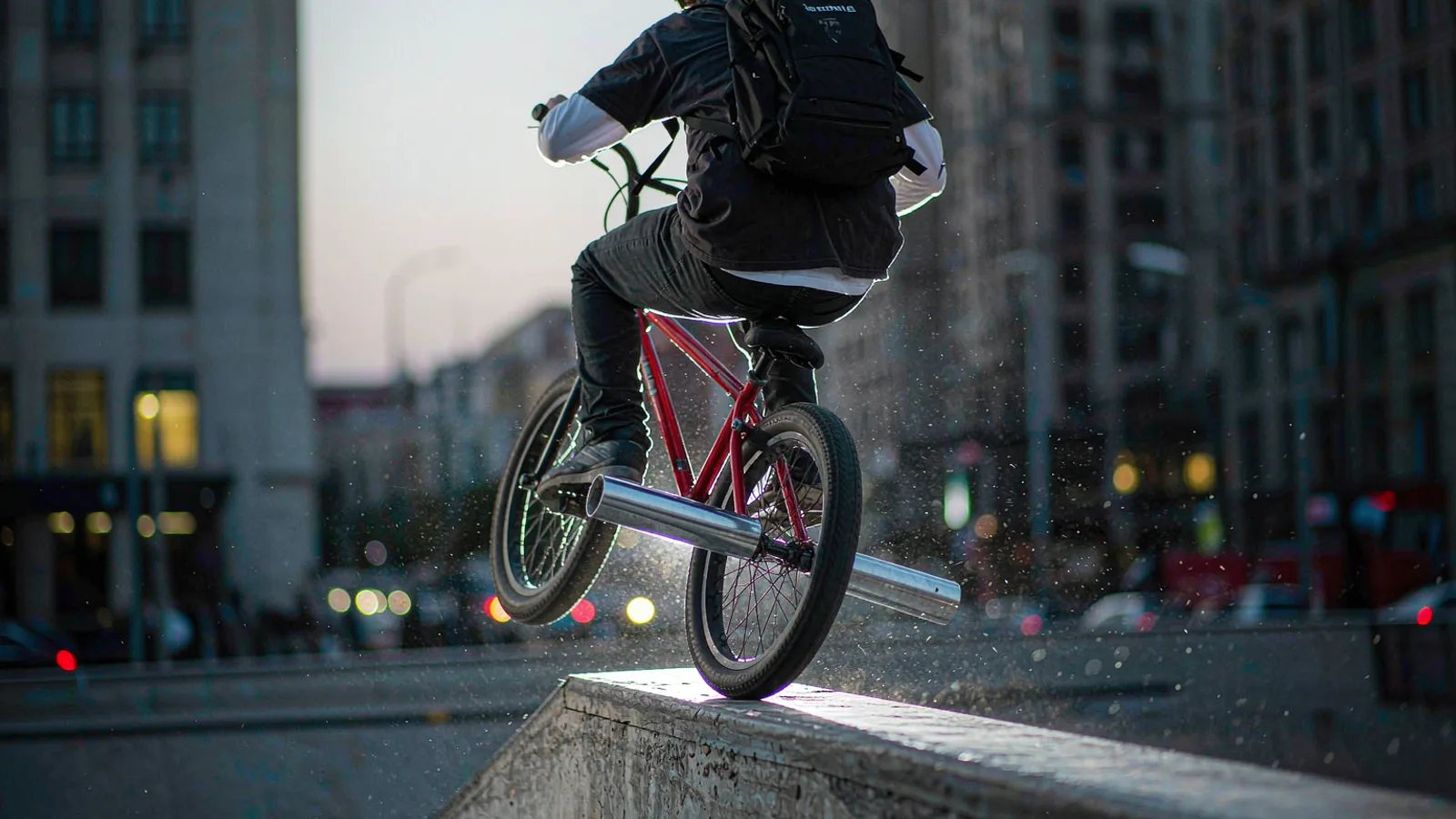
A BMX grind slides a designated part of the bike, often a peg, along an obstacle. In a double-peg grind the front and rear pegs on one side provide the named contacts; other grind families use different combinations of pegs and wheels. These contact patterns change the support of the bike, so understanding the equipment and the whole line comes before copying a trick name.
Confirm the bike is built for the task
A peg must be compatible with the hub, axle and installation arrangement. Not every BMX bike or axle is intended for pegs, and a component that fits visually can still be unsuitable. Follow the actual manufacturer instructions and have uncertain second-hand or modified equipment assessed.
Inspect the wheels, steering, drivetrain and attachments before riding. Cycling UK’s maintenance material provides a systematic inspection framework, not permission to install arbitrary grind hardware or a universal torque value. 1
A peg is more than its outer sleeve
Pegs can use different constructions. Odyssey’s Graduate is one concrete example: the manufacturer describes a steel core, a replaceable plastic sleeve and a specified axle size with an adapter. 3 Those are separate specifications. A replacement sleeve is not a complete peg, and an adapter does not authorize use on every hub.
| Component question | Information to obtain | A common mistaken shortcut |
|---|---|---|
| Axle and hub | Exact model and peg-use instructions | The bore fits, so the hub must support grinding |
| Core and sleeve | Whether the product uses a separate structural core | A sleeve-only listing supplies every needed part |
| Hub protection | Compatibility with the actual hub and dropout | Any guard can be added without changing assembly |
| Clearance | Relationship to the frame, fork and other parts | Matching axle diameter proves the whole installation |
This comparison explains what to identify; it is not an assembly procedure. Have the manufacturer’s instructions or a competent mechanic resolve the actual arrangement. Keep installation information alongside the pre-ride inspection record so a changed part is not confused with an unexplained handling change.
A grind name describes intended contacts, not the exact distribution of forces at every moment. During entry or exit a contact may be added or removed. That is why a photograph of the middle of a successful grind is insufficient to explain the entire movement.
Think about support and direction
During ordinary rolling, the wheels provide moving contact with the ground. A grind uses a different combination of support points. The rider’s position and motion influence how the system balances around them, while surface contact affects how the bike slides.
A centre-of-mass explanation can describe why balance matters without establishing a unique “correct” posture. The contact geometry changes among tricks and obstacles. A coach should explain the specific task instead of giving one weight-shift instruction for every grind.
Assess the whole line
The approach needs clear space and suitable control. The obstacle needs permission, acceptable condition and an understood surface. The exit needs somewhere appropriate to return to riding or stop. A low ledge with a poor exit is not automatically a low-consequence exercise.
Avoid modifying public surfaces or applying wax without legitimate permission. Such changes affect other users and do not solve the questions of traffic, pedestrians or an unsuitable landing area.
Separate skill stages
Ordinary turning, stopping and handling should be dependable in the practice area before a new grind is introduced. The change into contact and the exit out of it are skills in their own right. Repetition should focus on a suitable controlled task, not on a deadline for moving to a rail.
A successful attempt does not establish repeatable control. Discuss inconsistent contacts or exits with the instructor and simplify the exercise when necessary. Increasing speed can conceal a difficulty temporarily while adding consequence.
Recheck after impacts
Use an activity-appropriate helmet and other suitable protection, fitted and maintained according to their instructions. Helmet requirements have a specific scope; the US CPSC bicycle rule does not mean every helmet sold for a different sport is equivalent. 2
New play, a changed wheel alignment or unfamiliar noise after an impact calls for inspection before another run. A mechanical problem should not be diagnosed by attempting a more demanding trick. A good session preserves the bike’s predictable behaviour and the rider’s ability to choose a controlled exit.
Reader questions
Do all BMX bikes accept grind pegs?
No. Hub, axle, fork and frame requirements differ, and some bikes are not intended for peg use. Confirm the actual manufacturer's requirements rather than treating matching axle diameter as complete compatibility.
What is the difference between a peg core and a sleeve?
On a sleeved design, the core is the underlying component and the sleeve supplies the replaceable outer contact surface. Some pegs use other constructions. Identify the exact product before buying a sleeve, adapter or replacement part.
Sources and scope
Each reference supports the topic stated in its scope note. Worked examples are illustrative unless identified as measured results. Use current local information and the manual for your own equipment alongside appropriate practical instruction.
- Cycling UK: bicycle maintenance guidesGeneral bicycle inspection and maintenance background; use component-specific installation and torque instructions.
- CPSC: bicycle helmet requirementsThe US bicycle-helmet standard and the distinction from other sport helmets.
- Odyssey: Graduate peg construction and axle specificationOne product example of a steel core, replaceable plastic sleeve and specified axle/adapter; not approval for other hubs.
Continue reading
- BMX Pre-Ride Check: Wheels, Brakes and Bike Inspection
Organise a BMX pre-ride check and write a useful fault report. Download a reusable inspection log with clearly labelled fictional examples for a mechanic.
- Skatepark Etiquette: Taking Turns and Planning Lines
Learn skatepark etiquette for queues, shared lines, blind bowls and filming. Use a practical session example to choose where to wait, ride and finish.
- BMX Bowl Riding: How Pumping and Transitions Work
Understand BMX bowl pumping, transition shape and line choice. Compare banks, curved walls and coping before choosing a suitable coached session.