
Kitesurfing Wind Window: Power Zones and Apparent Wind
Understand the kitesurfing wind window, kite-position terminology and apparent wind. Learn what a diagram or wind-range chart leaves out of a real session.
By ActionSportsHQ Editorial · Published · 5 min read
At a glance
- The wind window is a model of kite positions relative to the wind, not a safe-zone map.
- Kite motion and rider motion change apparent wind and the forces experienced.
- Launching, landing, release systems and recovery require instruction with the actual equipment.
The kitesurfing wind window is a model of where a kite flies relative to the rider and wind. Position labels help discuss force and control, but they are not a map of harmless zones. Kite motion, rider motion, gusts, terrain and the actual control system all affect what happens during a session.
Locate the terms before comparing the forces
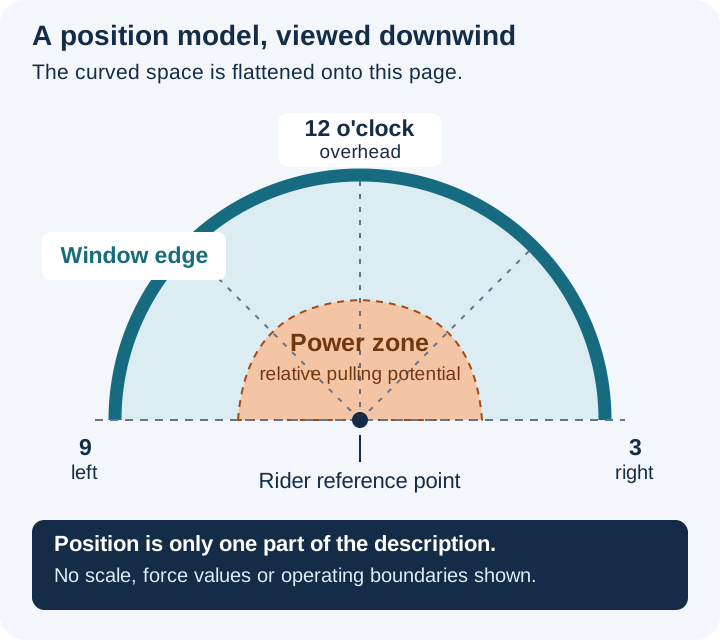
“Twelve o’clock” means overhead in this reference view, while the central power-zone label describes a region of greater pulling potential. Neither the area of the orange patch nor its distance from the arc is a measurable force value. The drawing also omits depth: a kite shown toward the centre is downwind of the rider, not directly beside them on the ground. 5
Here is a useful way to compare two photographs. Both might show a kite at the same clock position. In the first, the kite and rider are momentarily stationary; in the second, the kite is crossing that position while the rider travels. The position labels match, but the photographs do not record the same motion. You cannot rank their line loads from the clock label alone. IKO’s apparent-wind model explains the missing airflow information. 4
For a more useful lesson note, record three separate descriptions: where the kite is, how it is moving, and how the rider is moving. That produces a clearer question for an instructor than writing only “two o’clock.” It still leaves equipment, gusts and local effects to be assessed.
What the window model leaves out
The diagram is a simplified spatial model. It cannot show every gust, turbulence effect, obstacle or change in the rider’s movement. A kite near the edge can still exert force, and the surrounding terrain may make the situation unsuitable.
Avoid the statement that the edge of the window is automatically “safety.” What matters includes the whole equipment system, the current conditions and the user’s trained handling. A diagram is background for a lesson, not a launch approval.
Apparent wind changes with motion
The air motion experienced by a moving wing differs from the wind measured at a fixed place. Kite movement and rider movement can change the relative airflow, and therefore the forces on the system. IKO’s technical explanation distinguishes these moving-air relationships. 4 This explains why a kite’s behaviour cannot be predicted from surface wind speed alone.
Kite size is also only one variable. Design, trim, lines, rider and intended use matter. This article deliberately avoids a universal wind-speed-to-kite-size table or a rule that longer lines always create a fixed amount of extra pull.
Read the diagram as a moving reference system
| Term | What it helps describe | What the diagram cannot decide |
|---|---|---|
| Window edge | A boundary position relative to the airflow model | Whether a kite there is harmless in the actual conditions |
| Overhead position | A location above the rider in the model | Whether waiting there is appropriate at a particular site |
| Power zone | A region used to discuss stronger pulling potential | The exact load on this rider and equipment |
| Apparent wind | Airflow relative to a moving kite or rider | A complete prediction from one beach wind reading |
Cabrinha’s manual separates kite-position concepts from its warnings, operating-area requirements and equipment instructions. It also describes its wind-range chart as a reference whose relevance changes with rider and conditions. 3 That context matters more than extracting one reassuring diagram or number.
A good pre-lesson question is ‘How will we assess this launch area and learn this control system?’ A poor shortcut is ‘Which part of the picture is safe?’ The actual release and recovery methods must come from the provider and the exact equipment, rather than a generic online sequence.
Keep wave conditions separate from the wind-window discussion by using the surf forecast guide. To compare the equipment systems, the wing-foiling explanation distinguishes a hand-held wing from a kite connected by long flying lines.
Equipment handling is a practical skill
Control bars and release systems differ. Follow the actual manual and learn the relevant handling, checks and emergency procedures with a qualified provider. A generic sequence of buttons or pulls can conflict with the system being used.
IKO’s courses describe a structured kiteboarding training route. 1 Progress should follow demonstrated capability in an appropriate setting, not a fixed number of sessions before independent launching or a difficult-water objective.
Assess the site, not just the wind
Space, access, water conditions, other users and the route back all matter. Local rules can govern launch and landing areas. Coastal conditions and communication belong in the plan; RNLI’s risk guidance addresses the wider coastal context. 2
A familiar beach can change with the tide and weather. A forecast chosen for its reassuring number does not remove uncertainty about the actual location. If the necessary instruction, space or conditions are absent, choose a different objective.
Keep the lesson goal specific
A productive session may focus on a suitable handling task or understanding the equipment before board riding. Do not compress launching, independent riding and self-rescue into a short online procedure. Those subjects need practical teaching and assessment with the actual system. The wind-window model is most useful when it helps formulate better questions for that instruction.
Reader questions
Is the edge of the wind window a safe zone?
No part of the diagram is automatically harmless. A kite near the edge can still exert force, and gusts, terrain, obstacles and equipment change the situation. Learn site assessment and handling with suitable instruction for the actual system.
Why can a moving kite pull differently from a stationary one?
The airflow relative to the kite changes with its movement and the rider's motion. That apparent wind is different from a fixed shoreline measurement. Kite design, trim and current conditions also matter, so a beach reading alone cannot predict the load.
Sources and scope
Each reference supports the topic stated in its scope note. Worked examples are illustrative unless identified as measured results. Use current local information and the manual for your own equipment alongside appropriate practical instruction.
- IKO: kiteboarding courses and certificationsStructured kiteboarding training and progression.
- RNLI: coastal risksCoastal hazards and the importance of conditions, communication and appropriate preparation.
- Cabrinha: kite user manual and wind-window modelManufacturer explanation of kite positions, wind-window zones, conditions and the limits of wind-range charts; use the manual for your own system.
- IKO: induced wind, apparent wind and the wind windowTechnical explanation of relative airflow and kite motion, not a launch or emergency procedure.
- Cabrinha: wind-window terminologyPosition labels, overhead position and the relative-power model; not operating-area approval.
Continue reading
- How to Read a Surf Forecast: Height, Period and Direction
Decode surf forecast labels with worked component comparisons. Separate combined seas, swell period and direction, then keep a record using the Swell Component Lab.
- Wing Foiling Explained: Wing Power, Foil Lift and Control
Learn how wing foiling combines a hand-held wing with a hydrofoil. Compare it with kitesurfing and windsurfing, and understand the stages of learning.