
Windsurfing Basics: Sail Forces, Steering and Planing
Understand windsurfing sail forces, board and fin roles, introductory steering and planing. Compare learning stages without relying on a universal speed target.
By ActionSportsHQ Editorial · Published · 5 min read
At a glance
- The sail and the board interact with air and water; steering is not only a matter of pressing with the feet.
- Planing is a change in support and drag, not a universal speed threshold for every board.
- Learning, equipment and the route back must suit the actual wind and venue.
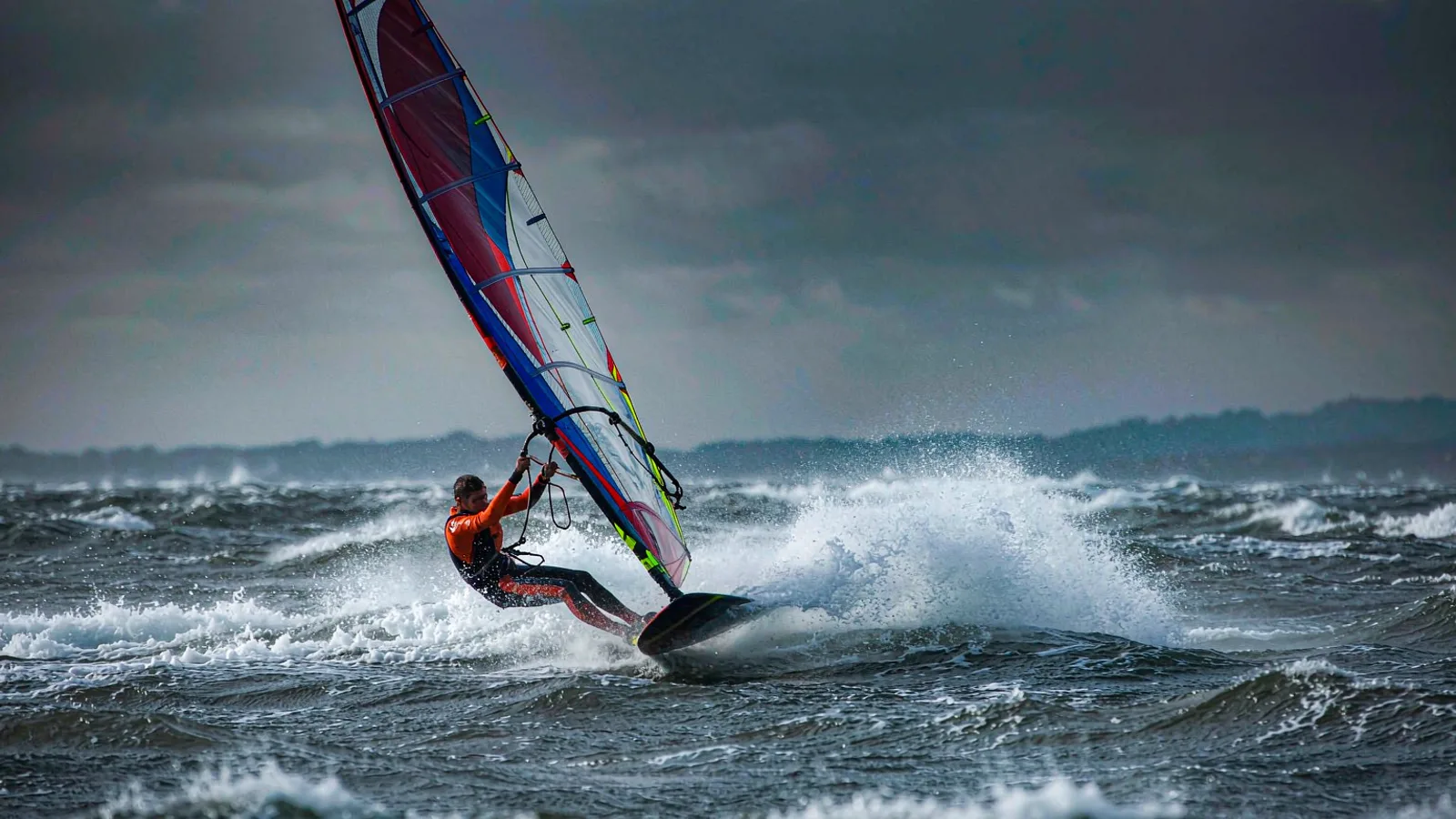
Windsurfing uses a sail rig attached to a board, with the rider controlling the rig as the board and fin interact with water. Early steering and faster planing control involve related but different tasks. Understanding the sail, underwater surfaces and rider together is more useful than describing windsurfing as steering only with the feet.
The sail produces a force with direction
A sail’s orientation to the apparent wind affects the forces on it. Apparent wind includes the influence of the rider’s motion, not only the wind measured on shore. The resulting force is balanced by the board, fin and rider’s interaction with the water.
This simplified explanation does not tell a learner how far to sheet in for every situation. Sail design, course, speed and the task vary. Introductory handling is best learned with a suitable rig in a supervised setting.
Steering changes with the stage of riding
At introductory speeds, moving and tilting the rig affects the balance of the system and its turning behaviour. At faster speeds, board and rail control become more prominent. Those are related skills, but not one universal foot-pressure instruction.
A coach can select exercises that teach one response at a time. The RYA’s training pathways distinguish introductory handling from more advanced windsurfing tasks. 1 Completing a start exercise does not imply readiness for strong wind or demanding water.
What planing describes
As conditions and speed change, the board can receive more dynamic support from its movement over the water. That transition changes the handling and resistance. The speed at which it occurs depends on the board, rig, rider and conditions.
Do not infer a safe session from a single planing-speed number or a sail-size table. A bigger sail can increase handling demands as well as available force. The whole setup should fit the lesson and the venue.
Compare the learning tasks before comparing speed
| Learning topic | Question it answers | What it does not yet establish |
|---|---|---|
| Rig handling | How the learner manages the sail in a suitable exercise | Independent control in stronger or variable wind |
| Introductory steering | How the system responds during low-speed turns | Reliable higher-speed manoeuvres |
| Returning to the start | Whether the planned route can be completed | Suitability of a different wind direction or venue |
| Planing skills | How handling changes with dynamic board support | A universal threshold for every board and rider |
The RYA separates introductory handling from later windsurfing skills in its training pathway. 1 That is a reason to identify what a course teaches rather than select it solely for a promised speed or a photograph of advanced riding.
Imagine a learner who can move away from shore on one course but has not demonstrated the return required by the session. Increasing sail area does not answer the missing route-control question. A useful lesson goal is completing an appropriate route under the instructor’s arrangement, then deciding what skill comes next. This is an illustrative learning example, not a sailing instruction.
When comparing equipment, identify the board, fin or daggerboard where fitted, sail, mast, boom and joint as a complete rig. Similar sail area does not imply identical handling or compatible parts. Use the manufacturer’s actual rigging instructions.
The wing-foiling comparison explains why a hand-held wing and an attached windsurf rig have different connections. The wave-forecast guide helps separate sea conditions from a wind reading. These distinctions prevent an equipment or weather label from standing in for the whole lesson plan.
Preparation includes the return route
Follow the actual assembly, inflation or rigging instructions for the equipment used. Inspect the mast, boom, joints, sail and board according to the manufacturer or training provider. A component that looks attached is not necessarily configured correctly.
Wind direction, weather, access and available assistance matter. RNLI’s surf-sport guidance provides safety context, including windsurfing considerations; current local advice and equipment instructions remain necessary. 2 Being able to move away from shore does not prove the ability to return under the same conditions.
Build the skill before enlarging the objective
Work toward controlled handling and an understood way to finish the selected task. Learn specialist harness, footstrap and higher-speed skills through appropriate instruction rather than combining them into a short online progression.
If conditions change or the learner cannot manage the planned route, simplify the exercise or stop. A useful progression is repeatable control in a suitable environment, not a promise of planing by a fixed week.
Reader questions
What does planing mean in windsurfing?
Planing describes a stage in which motion over the water provides more dynamic support to the board, changing handling and resistance. The transition depends on the board, rig, rider and conditions; one speed is not a universal threshold.
Is windsurfing steered only with foot pressure?
No. The rig, board, fin and rider interact. Introductory rig movement and faster board control are different learning tasks. A coach should relate the response to the equipment and stage of riding rather than prescribe one foot-pressure rule.
Sources and scope
Each reference supports the topic stated in its scope note. Worked examples are illustrative unless identified as measured results. Use current local information and the manual for your own equipment alongside appropriate practical instruction.
- RYA: windsurfing training pathwaysStructured windsurfing training from introductory handling to more advanced skills.
- RNLI: surf-sport safety guideSurf-sport and windsurfing safety considerations; local advice and current equipment manuals prevail.
Continue reading
- Wing Foiling Explained: Wing Power, Foil Lift and Control
Learn how wing foiling combines a hand-held wing with a hydrofoil. Compare it with kitesurfing and windsurfing, and understand the stages of learning.
- How to Read a Surf Forecast: Height, Period and Direction
Decode surf forecast labels with worked component comparisons. Separate combined seas, swell period and direction, then keep a record using the Swell Component Lab.