
Mountain Layering System: Base, Midlayer and Shell
Plan clothing for ascent, stops and the return. Use a downloadable layering field log and a fictional worked record to separate garment, fit and packing problems.
By ActionSportsHQ Editorial · Published · 7 min read
At a glance
- Name the clothing worn and the spare insulation available for each phase of the outing.
- Record where moisture or awkward adjustments occurred before deciding what to buy or change.
- Download a field log with blank phase rows and a clearly labelled fictional example.
A mountain layering system has to work while you move, while you stop and when the return takes longer than planned. A useful packing record therefore follows the phases of an outing, rather than listing jackets without saying when they will be used. This guide provides an original field-log format and a completed fictional example.
Download the layering field log: blank phase rows and a fictional worked record (CSV). Save a copy on your own device, replace the blank rows with your observations and remove the FICTIONAL_EXAMPLE rows before treating it as your own record.
Give the clothing jobs names
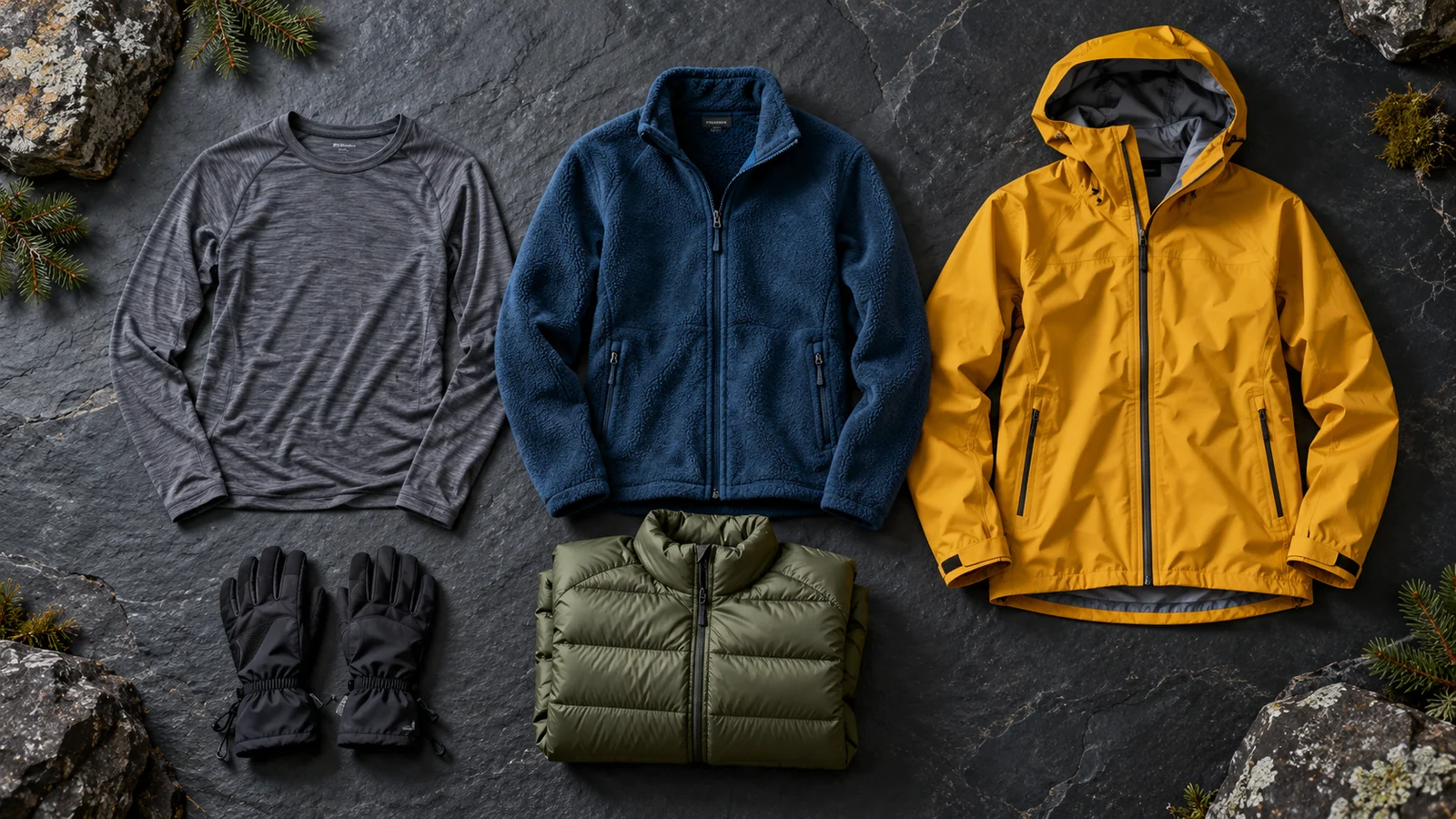
The three familiar roles are moisture management next to the skin, insulation and protection from wind or precipitation. REI’s layering guide explains these roles and why activity level matters alongside the weather. 1
Assign short identifiers to the garments you already own. In the fictional example below, B means a base top, S a shell and I an insulated jacket. These are labels for a record, not a recommended outfit. List lower-body clothing, gloves, headwear and footwear in your own version too.
| Record item | Useful detail | Detail that is insufficient alone |
|---|---|---|
| Garment identity | Your label plus model or construction if known | “Warm jacket” |
| Combination | What was worn together in that phase | Everything that was somewhere in the pack |
| Spare insulation | Where it was packed and its observed condition | “Extra layer available” |
| Equipment interaction | What happened with the pack, gloves or required activity equipment | “Fits well” without the combination |
Try the combination at home before relying on it outdoors. Record whether closures, cuffs and hoods remain usable with the other pieces and your actual equipment. An interaction such as “shell cuff catches on glove closure” gives a specific question to resolve.
Fill in the forecast context once, then the phases
Keep the forecast service, issue time, valid period and relevant location or height with the record. The Met Office explains that mountain tables contain height-specific information and that the written forecast can describe variations omitted from a table. 3 Read the complete product for your area; a saved headline alone leaves out that context.
Then use one row per phase:
| Phase | Record before leaving | Add after observation |
|---|---|---|
| Ascent or active movement | Intended combination and accessible adjustments | Work pattern, weather observed and where clothing became damp |
| Stop or waiting period | Spare insulation location and how it fits with other layers | What was added and any difficult closure or access |
| Return | Clothing options for a slower pace or changing weather | What remained usable and what changed |
| Review at home | A question to investigate | The specific comparison or fit check to make next |
Forecast and observation are separate columns. “Rain forecast” and “no rain observed during this short walk” can both be true. Keep the time and area attached to each, rather than treating one observation as a verdict on an entire forecast.
The National Park Service identifies getting chilled and wet as a concern in mountain recreation. 2 The log is for clothing planning and equipment feedback. It supplies no temperature threshold, medical assessment or reason to continue an unsuitable outing.
Worked record: moisture on the climb, an awkward cuff at the stop
All entries in this example are fictional editorial material. No outing, garment test or measured performance is being reported. The setting is a short practice walk with shelter nearby, not a mountain route recommendation. The weather descriptions below are invented observations, not a current forecast.
| Phase | Fictional clothing and packing | Fictional observation | Question or follow-up |
|---|---|---|---|
| Active climb | B and S worn; I in a dry bag near the pack opening | Damp patch at the back beneath the pack; light rain noted | Keep pack contact, work pattern and shell use in the same note |
| Sheltered stop | B, I and S worn; the combination had been tried on beforehand | I was easy to retrieve, but closing S’s cuff over the glove was awkward | Repeat that closure check with the same glove at home |
| Slower return | B and S worn; I returned to its own bag while S remained in use | Notes identify which garment was damp rather than saying “everything wet” | Check the condition of each piece during unpacking |
| Home review | B, I, S and the same gloves available | Cuff interaction can be examined without wind or time pressure | Resolve the fit issue before relying on the combination again |
The download keeps these entries in separate rows. Each row has a place for the work pattern, the layers worn, spare-layer location, observation and next comparison. The fictional forecast fields explicitly say that no real forecast was used.
Read the record before buying another layer
The fictional log contains two different problems: moisture at one body location and an awkward clothing interaction. They deserve different follow-up questions.
The damp patch establishes an observation, not a material diagnosis. The record does not measure moisture transport or identify whether perspiration, precipitation or another factor produced it. A different pack, pace or clothing combination would add more changed variables. Calling the shell defective from this row would go beyond the evidence.
The cuff note identifies a repeatable fit question. Recreate the combination at home and check the actual closures and instructions. A new, thicker insulated jacket might leave the cuff problem unchanged. A record precise enough to name the glove and sleeve is more useful than “need warmer gear.”
The packing note identifies access, not insulation performance. Retrieving I promptly shows that the packing arrangement worked in this invented example. It does not rate the jacket’s warmth or show that the same spare clothing is sufficient for a remote delay.
For a later low-consequence comparison, write the question first and record what changed. Changing clothing, work rate and pack at the same time may still produce a useful personal note, but it cannot isolate one cause. Describe the result in those terms instead of turning it into a product ranking.
Keep activity-specific questions with the activity
A clothing log can travel between outings; specialist requirements still need their own preparation. During ski touring, changing equipment modes also creates a stationary phase. During ice climbing, a waiting partner’s work pattern differs from the climber’s. Between bouldering attempts, access to an extra layer can matter without resolving the separate landing question.
Use those differences to label the phase precisely. “Waiting at an exposed stance” and “walking continuously” are more informative than calling both a mountain day. Keep the forecast, intended duration, shelter and options for changing the plan with the clothing discussion.
After use, inspect, dry and care for the garments according to their own labels. Preserve one concrete question for the next review: a closure to check, an item to keep accessible or a missing clothing role to discuss with a suitable provider. That creates a reason for a change that can be traced to the record.
Source check: 3 November 2026. The field-log design, fictional entries and interpretation are ActionSportsHQ editorial material. They are not manufacturer test results or an approved mountain-equipment checklist.
The forecast context also needs an altitude reference. The freezing-level and cloud-base guide separates product definitions and height references before those labels are copied into a clothing record.
Reader questions
Can I use a layering log to compare two jacket brands?
It can document what happened with your own combination. Different weather, work rate, pack and underlying clothing prevent a simple brand comparison between two outings. A personal note is not a controlled performance test.
Do I need to publish my route to use the field log?
No. Save the CSV on your own device and use an outing label. Keep the forecast region, relevant height and time for your own interpretation; the worksheet asks for no name, contact details or exact GPS track.
Sources and scope
Each reference supports the topic stated in its scope note. Worked examples are illustrative unless identified as measured results. Use current local information and the manual for your own equipment alongside appropriate practical instruction.
- REI: layering basicsThe different functions of base, insulating and weather-protection layers.
- National Park Service: hypothermia preventionCold and wet exposure, clothing choices and prevention in mountain recreation.
- Met Office: mountain forecast guideAltitude-specific wind, gusts, visibility and the limits of area weather summaries.
Continue reading
- Mountain Forecasts: Freezing Level, Snow Level and Cloud Base
Learn what freezing level, snow level and cloud base mean in mountain forecasts, how height references differ and why existing snow cover is a separate record.
- Ski Touring vs Skimo: Skins, Gear and Transitions
Compare ski touring, ski mountaineering and skimo racing. Understand climbing skins, boot and binding modes, and how to organise a transition.
- Ice Climbing Equipment: Tools, Crampons and Protection
Understand ice-climbing tools, boot-crampon compatibility and protection roles. Compare equipment questions without treating ice colour as a strength test.
- Bouldering Landing Zones: Crash Pads and Spotting
Assess outdoor bouldering landing zones, crash-pad gaps, changing fall directions, spotting limits and the descent before choosing a problem.