
Whitewater Kayaking Basics: Eddies, Holes and Skills
Understand whitewater kayaking eddies, hydraulics and river grades. Separate flow features, boat-control skills and swimming context before choosing a run.
By ActionSportsHQ Editorial · Published · 5 min read
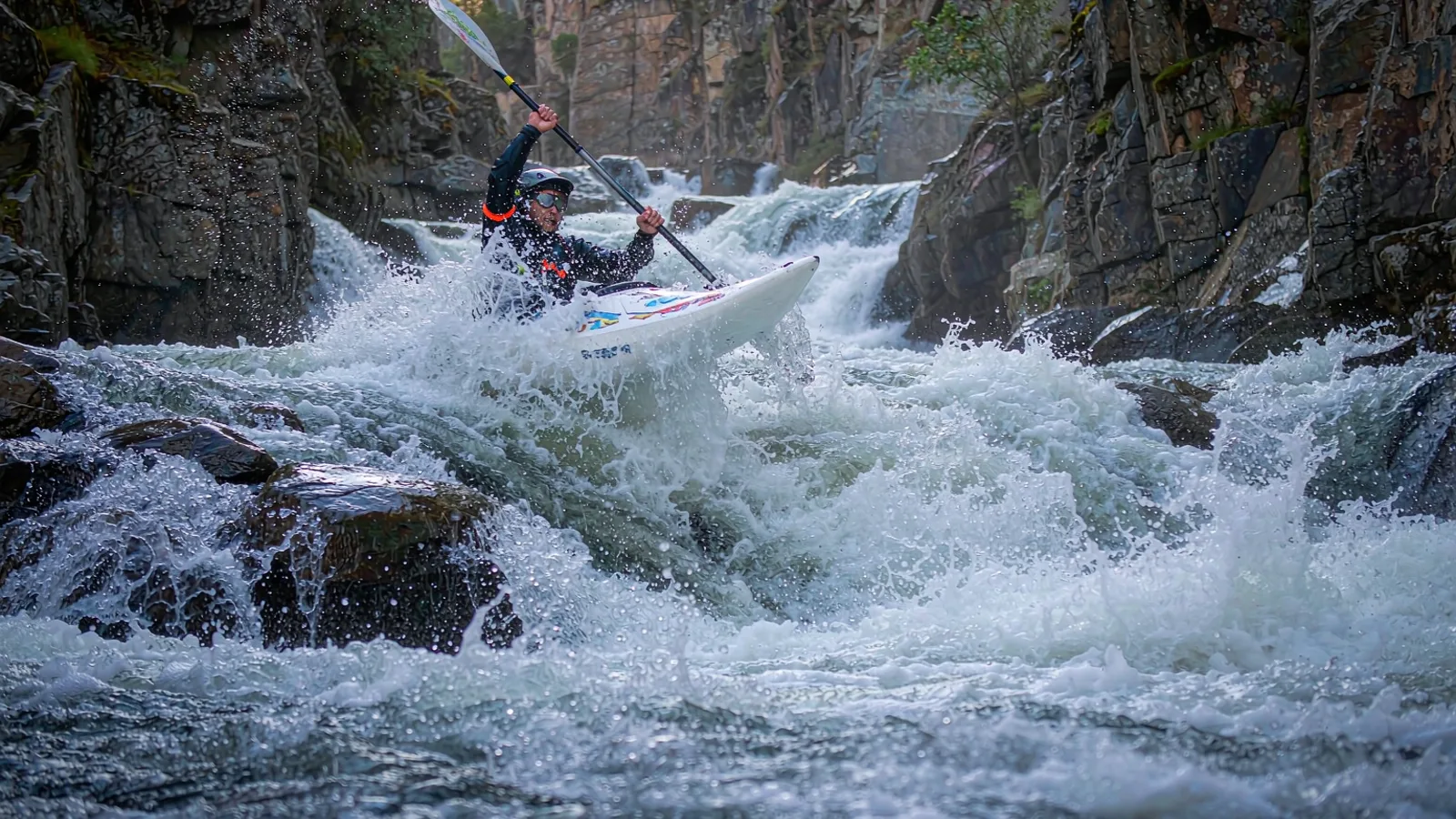
At a glance
- Difficulty depends on features, flow and consequences, not a direct gradient-to-class formula.
- For defensive swimming in shallow or obstructed rapids, the reference distinguishes feet held high from feet pointed downstream.
- A pool roll and a calendar do not establish readiness for advanced river running.
Whitewater kayaking combines boat-control skills with reading current, eddies, hydraulics and the consequences of a missed line. A feature name describes part of the flow, not whether it is suitable to enter. River level, obstructions, access and the actual group’s preparation all belong in the decision before choosing a run.
Read features as changing flow
An eddy is an area of flow differing from the main current, often behind a feature. It can provide a useful stopping or manoeuvring location, but its size and behaviour change with water level and the surrounding geometry.
A hydraulic or hole can include recirculating flow. Not every hole behaves identically, and an appearance seen from one angle does not establish an escape route. Avoid a universal instruction to “punch through” or “always exit the boat.” The appropriate decisions require trained assessment of the actual feature.
Grade is not a gradient equation
River class summarises difficulty and must be interpreted with local information. A percentage gradient cannot determine it by itself. Water level, the arrangement of features, continuity and consequences also matter. American Whitewater’s 2024 scale summary states that ratings are approximate and need additional river information. 2
A known reach can change after high water or new obstructions. A guidebook is background; obtain current information before planning a trip. Include the ability to stop, scout, portage or change the objective where appropriate.
Be precise about swimming directions
The words “feet down” are ambiguous and should not be used as a generic river-swimming instruction. They can be confused with putting feet toward the riverbed rather than pointing them downstream.
American Whitewater’s Safety Code describes defensive swimming in shallow or obstructed rapids with the feet held high and pointed downstream. It also distinguishes other swimming contexts and cautions against standing in fast-moving water because of foot entrapment. 1 Learn these skills through suitable swiftwater instruction; the description here is not a universal response for every hydraulic or obstacle.
Separate the flow feature from the skill you want to learn
| Term | What it describes | The additional question |
|---|---|---|
| Eddy | Flow that differs from the main current, often behind a feature | Is there an appropriate stopping place and a manageable entry and exit? |
| Eddy line | The boundary between differing flows | What control does crossing this particular boundary require? |
| Wave | A surface feature in the moving water | What lies downstream and what happens if the intended line is missed? |
| Hydraulic or hole | A feature that may involve recirculating flow | Can the actual behaviour and consequences be assessed with appropriate expertise? |
These terms organise observation; they do not give a universal manoeuvre or escape response. American Whitewater’s Safety Code puts river features within wider planning and hazard awareness. 1 The same named feature may behave differently when flow changes or new material enters it.
For example, a paddler may practise a turning skill in a managed teaching setting and later see an apparently similar eddy on an unfamiliar run. Similar appearance does not establish the same approach, boundary, downstream consequence or recovery opportunity. This hypothetical comparison shows what information is missing before transferring a skill.
Keep learning records specific: the task demonstrated, conditions, equipment and supervision. A pool roll is valuable practice but does not by itself establish river-reading, swimming or group-rescue capability. Use the river-grade planning guide to separate technical class from flow and consequence. For cold waits or a delayed return, the layering guide addresses another preparation question, without substituting land-clothing advice for specialist paddling equipment.
Practise foundational skills in an appropriate setting
Wet exits, rolling, braces and moving-water manoeuvres require supervised teaching and suitable equipment. A reliable pool roll is useful, but turbulent water, fatigue and equipment differences can change the task. A roll does not remove the need for swimming and group safety skills.
Do not promise advancement to Class V after twelve weeks. Readiness depends on demonstrated skills, judgment and the demands of a particular route. The group needs appropriate shared communication and rescue preparation, not only one confident paddler.
Choose the trip before choosing the hardest feature
Discuss the whole run, current flow, access, exits and conditions with a suitable local group or instructor. Select an objective that fits the actual participants and retain the option to change it. The ability to explain why a feature is unsuitable is part of river skill, not a failure to progress.
Use the dedicated river-difficulty guide to organise the route questions. It offers context for the grade, not a checklist that can score a river as safe.
Reader questions
What is an eddy in whitewater kayaking?
An eddy is an area of flow that differs from the main current, often behind a feature. Its boundary, size and behaviour depend on the river level and geometry. Whether it offers a suitable stopping place requires assessment of the actual feature.
Does a reliable pool roll make me ready for a whitewater river?
Not by itself. Moving-water control, swimming context, hazard recognition, communication and rescue preparation are separate skills. Choose a run with suitable instruction and current local information rather than treating one pool skill as complete river readiness.
Sources and scope
Each reference supports the topic stated in its scope note. Worked examples are illustrative unless identified as measured results. Use current local information and the manual for your own equipment alongside appropriate practical instruction.
- American Whitewater: Safety Code, revised 2024Planning, river hazards and swimming context; this is not a rescue course.
- American Whitewater: International Scale of River DifficultyThe Class 1–5 overview in the revised 2024 summary and the limits of interpreting a grade.
Continue reading
- Whitewater River Grades: Classes, Flow and Consequences
Understand whitewater river grades and Class I–V descriptions. Compare a rapid rating with flow, continuity, access and consequences when planning a trip.
- Mountain Layering System: Base, Midlayer and Shell
Plan clothing for ascent, stops and the return. Use a downloadable layering field log and a fictional worked record to separate garment, fit and packing problems.