
Parkour Vaults: Obstacle Assessment and Progression
Understand parkour vault planning through obstacle shape, hand support, approach and landing space. Compare training conditions before choosing a movement.
By ActionSportsHQ Editorial · Published · 5 min read
At a glance
- A vault includes the approach, obstacle contact and landing route; the obstacle alone is not the task.
- Surface strength, grip and access must be checked before practising.
- A named vault is not a prescribed next step; suitable coaching should adapt the exercise to current ability.
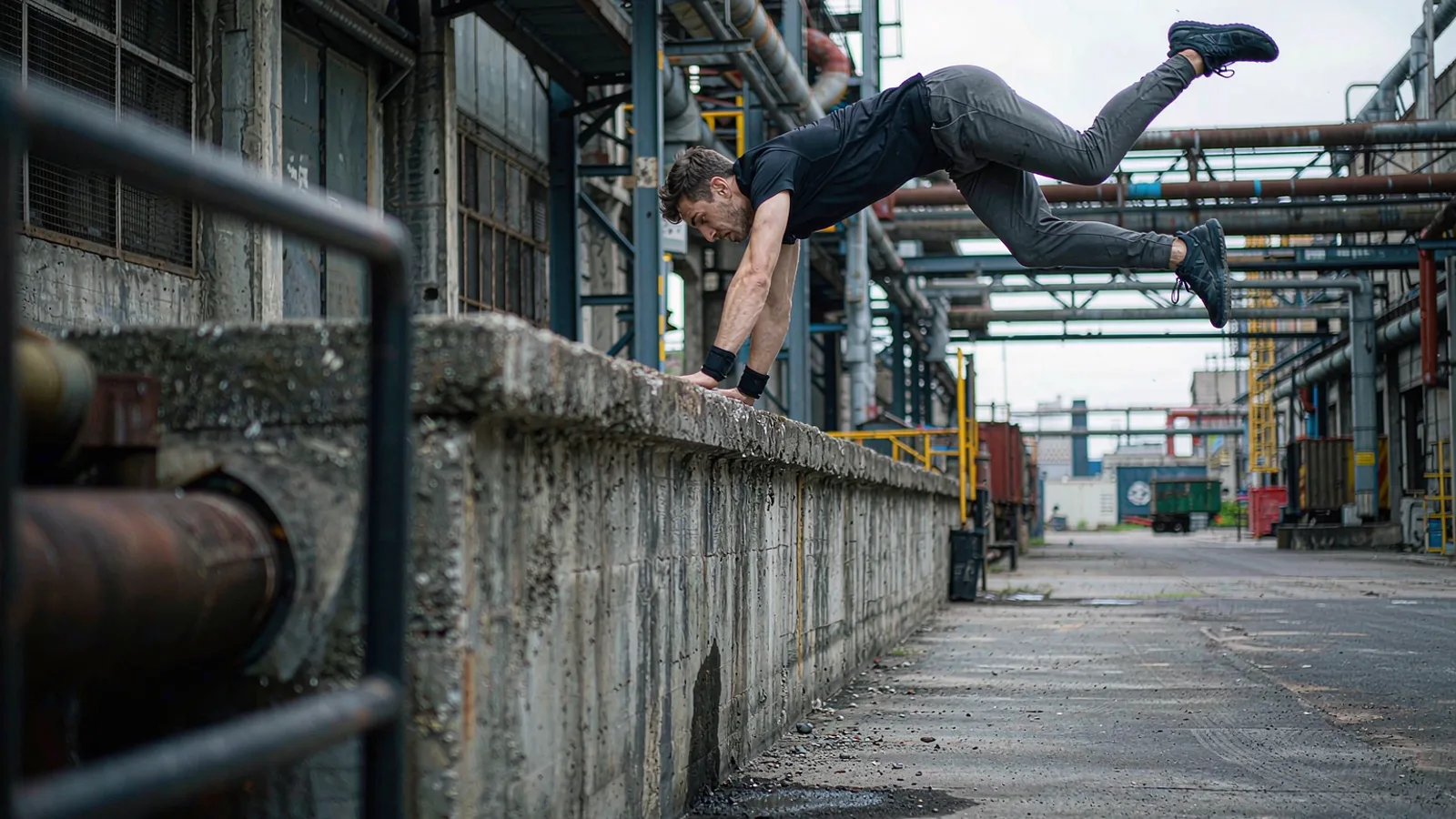
A parkour vault uses a pattern of hand and body contacts to move over an obstacle. Choosing a vault begins with the approach, obstacle dimensions, surface condition and landing route, not a list of tricks to complete. A familiar movement on a different wall can become a different task even when the wall is the same height.
Assess the environment before the movement
Check permission to use the space and whether others can enter it unexpectedly. Look at the condition of the obstacle and both sides of the route. A solid-looking wall may have a loose top or an unseen hazard beyond it. Wetness, debris and surface damage can alter the task.
Do not use an unfamiliar feature simply because its height resembles one practised elsewhere. Width, shape, grip and landing conditions change the movement. A route that is easy to enter but difficult to exit is not fully assessed.
Understand contact without turning it into a recipe
A vault changes how the body is supported while it moves. Hand contact, leg movement and momentum interact, and different vault families organise those contacts differently. The ability to make one contact comfortably does not guarantee control of the complete sequence.
An explanation of mechanics can help ask useful questions: which contact changes direction, where is clearance needed, and what happens if the intended support is lost? It cannot replace supervised practice or give one hand-placement rule for every obstacle and person.
Compare obstacles by more than height
Imagine a low training block in a coached gym and a wall of the same height outdoors. The gym block has a known shape and a managed landing area. The outdoor wall may have a wider top, a sloping far side, moisture or a pedestrian path behind it. Equal height does not make the contacts or consequences equivalent.
| Variable | Question before choosing the movement |
|---|---|
| Width and top shape | Can the intended support and clearance be understood from both sides? |
| Surface | Is there damage, loose material, moisture or contamination? |
| Approach | Can the exercise begin predictably without another user entering the route? |
| Landing and continuation | Is there room for the intended finish, including a controlled stop? |
| Practice arrangement | Can a coach reduce the task without increasing consequence? |
The table is an observation aid, not a strength test for structures or a vault tutorial. Its value is identifying the variable that changed. If a gym exercise works but an outdoor feature feels different, ‘same height’ is an incomplete explanation; compare width, support, approach and exit separately.
Parkour UK’s standards place organised practice in a responsible coaching context. 1 A useful coaching discussion starts with the movement goal and the available environment. It does not require every learner to select the same named vault. For the shared-space part of a session, the park etiquette article offers observation principles, while the bouldering landing guide illustrates why a landing needs its own assessment. Neither transfers a climbing or skating technique into parkour.
Let the exercise fit the learner
A qualified coach can choose a low-consequence task that matches existing control and adapt it as skill develops. Parkour UK’s coaching standards are a reference for responsible organised instruction. 1 The standards are not a certificate that any particular online vault demonstration is suitable to copy.
Avoid calendar-based claims such as completing a kong vault after a fixed number of sessions. Strength, mobility, coordination, prior experience and the actual task vary. Demonstrated control is more meaningful than the date on a training plan.
Include the landing and the next action
Before attempting a movement, identify where it ends and how to stop or continue without entering another hazard. The landing area should not require an unplanned change of direction at the last moment. A move that clears the obstacle but leaves no controlled exit is incomplete.
This article does not prescribe landing technique for every height or direction. Practical instruction should address the selected movement and teach appropriate responses in a controlled setting. An ability to tolerate impact is not a reason to increase consequence.
A good session preserves choice
Keep the training space appropriate, communicate with partners and stop when a critical condition is no longer met. Participant welfare is part of organised parkour, including avoiding pressure to attempt a task beyond current readiness. 2
Progress may be choosing a better route, recognising an unsuitable obstacle or repeating a simple movement with more control. Moving efficiently includes making sound choices about where and when to move, not treating every wall as a challenge that must be crossed.
Reader questions
Can I choose a parkour vault just from the obstacle height?
No. Width, top shape, surface grip, approach and the space beyond the obstacle also affect the task. A coach can adapt a movement in a controlled setting, but a height match alone does not establish a suitable outdoor feature.
What should a beginner discuss with a parkour coach?
Describe current movement control, the specific exercise goal and any uncertainty about support or landing. Ask how the task can be simplified and what a controlled finish looks like, rather than choosing a deadline for learning a particular vault.
Sources and scope
Each reference supports the topic stated in its scope note. Worked examples are illustrative unless identified as measured results. Use current local information and the manual for your own equipment alongside appropriate practical instruction.
- Parkour UK: coaching standardsResponsible coaching standards, including appropriate sessions and progression.
- Parkour UK: safe sportParticipant welfare and the responsibilities of organised parkour activity.
Continue reading
- Skatepark Etiquette: Taking Turns and Planning Lines
Learn skatepark etiquette for queues, shared lines, blind bowls and filming. Use a practical session example to choose where to wait, ride and finish.
- Bouldering Landing Zones: Crash Pads and Spotting
Assess outdoor bouldering landing zones, crash-pad gaps, changing fall directions, spotting limits and the descent before choosing a problem.