
Paragliding Airspeed vs Groundspeed: How Wind Adds
Compare paragliding airspeed and groundspeed with headwind, tailwind and crosswind examples. Learn how velocity vectors differ from a GPS speed reading.
By ActionSportsHQ Editorial · Published · 6 min read

At a glance
- Airspeed compares movement with the surrounding air while groundspeed compares movement with the ground.
- Add velocity vectors with a stated direction convention; simple headwind subtraction applies only to aligned motion.
- A horizontal ground track or GPS speed does not by itself describe airspeed, vertical motion or launch suitability.
A paraglider’s airspeed is its speed relative to the surrounding air; groundspeed is its speed relative to the ground. Ground velocity equals air-relative velocity plus wind velocity. For fixed, aligned air-relative motion, headwind reduces groundspeed and tailwind increases it. Crosswind requires adding directions as well as speeds.
A GPS speed therefore cannot be read as the speed of air passing the wing. The horizontal diagrams and invented numbers below explain the reference frames. They leave vertical motion, changing wind and the actual wing’s performance outside the calculation.
State the reference before stating the speed
The FAA glossary defines airspeed relative to the air mass and distinguishes indicated airspeed from true airspeed. 1 Here, “air-relative velocity” means the actual horizontal movement of the glider relative to the local air, rather than the reading of a particular instrument.
NASA’s ground-reference explanation treats wind and ground motion as vectors and relates their difference to air-relative motion. 2 Rearranged for our diagrams:
Ground velocity = air-relative velocity + wind velocity.
A vector includes direction as well as magnitude. “20 km/h” is a speed; “20 km/h eastward relative to the air” also supplies the direction and reference needed for addition. Keep all terms in the same units and refer to the same interval and location.
| Term used here | Compared with | What a single value leaves out |
|---|---|---|
| Horizontal air-relative velocity | The local air mass | Vertical motion and instrument-specific speed definitions |
| Wind velocity | The ground | Variations at other heights, places and times |
| Horizontal ground velocity | The ground | Air-relative motion unless the local wind is also known |
| Groundspeed | Magnitude of horizontal ground velocity | Direction, vertical movement and the separate component vectors |
Headwind and tailwind: the aligned example
Imagine an object moving 20 km/h eastward relative to the air. Use east as the positive direction. The invented wind is exactly aligned with that axis, steady and uniform. We ignore vertical motion and all changes in the object’s air-relative speed. These are a horizontal, level-plane arithmetic model, not a claim that an unpowered paraglider remains level.
With an 8 km/h westward headwind, the signed calculation is:
+20 + (−8) = +12 km/h eastward over the ground.
With an 8 km/h eastward tailwind, it is:
+20 + (+8) = +28 km/h eastward over the ground.
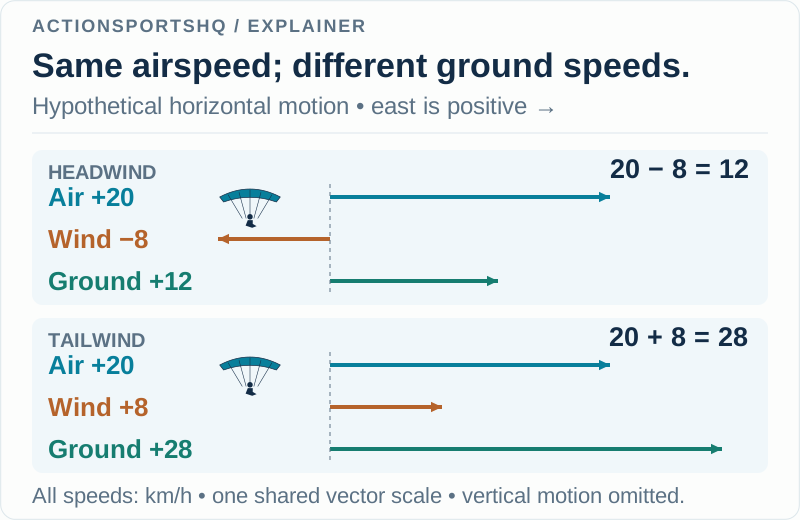
The 12 and 28 are not two different airspeeds. They are two ground results for the same stipulated air-relative motion. The wind has changed the relationship with the ground in this model. Reading 28 from a GPS display would not show that 28 km/h of air is passing the wing.
Wind descriptions often state where wind comes from, while our arrows point where the air moves toward. In this eastward example, wind from the east moves west and contributes −8. Writing both conventions explicitly prevents a sign error that a bare “east wind” label could conceal.
Crosswind: add components instead of subtracting a speed
Keep the invented air-relative velocity at 20 km/h eastward, but now let the wind move 8 km/h northward. With the air-relative heading fixed, the components of ground motion are 20 east and 8 north. The forward component remains 20; the total ground vector points northeast of east.
NASA’s crosswind explanation separates lateral wind from the aircraft’s direction and resulting ground path. 3 Our own arithmetic gives a magnitude of:
√(20² + 8²) = √464 ≈ 21.5 km/h.
The angle is approximately arctan(8 / 20) = 21.8° north of east. This angle describes the invented ground vector, not a recommended heading correction.
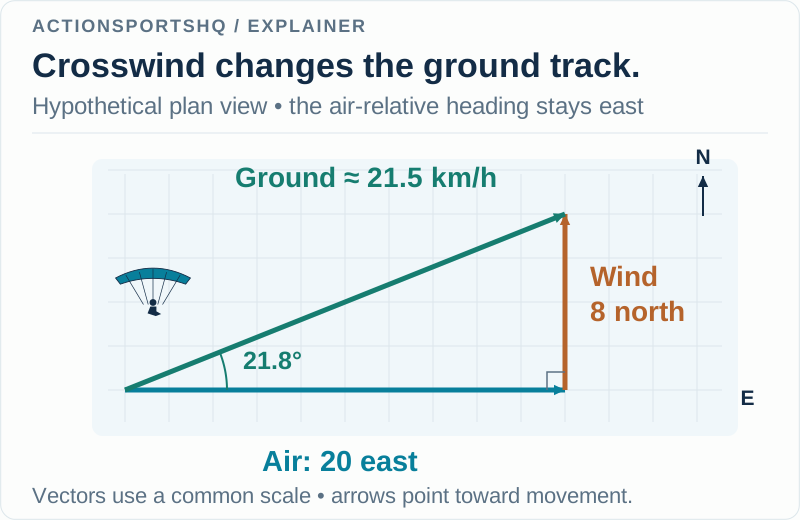
Subtracting 8 from 20 would answer the earlier headwind problem, not this crosswind problem. Adding the two magnitudes to get 28 would also discard their perpendicular directions. Breaking each vector into east-west and north-south components keeps the geometry intact.
Holding an eastward ground track would be a different assumption from holding an eastward air-relative heading. Do not combine a diagram drawn for one with numbers calculated for the other. This guide stops at interpreting the vector relationship rather than providing a course-setting procedure.
Use displacement to check the explanation
An alternative way to verify the crosswind example is to imagine a ten-minute interval. At the stipulated constant rates, the object moves 20 × 10/60 = 3.33 km east relative to the air while the air moves 8 × 10/60 = 1.33 km north relative to the ground. The two displacements add to a diagonal ground displacement.
That invented interval makes the references visible. A marker carried with the air and a marker fixed to the ground would not see the same displacement. There is no contradiction in their reports because they use different reference frames.
Do not turn the interval into an available-flight-distance estimate. The example contains no height, descent rate, lift, sink, wind gradient or terrain. Nothing in its horizontal triangle predicts how long a glider can remain airborne or whether it can reach a location.
Ask what a real observation establishes
A track log with a speed and direction documents ground-relative movement within the limitations of that recording. A wind measurement at a launch documents a different location and time from air encountered elsewhere. Combining them without matching context can produce an apparently precise airspeed with an unknown error.
For a classroom comparison, record the quantity, units, reference, direction convention and assumptions together. “GPS groundspeed, km/h, track toward east, timestamp recorded” is more interpretable than “wing speed 28.” If the wind is merely assumed, label it as assumed.
Use the paragliding weather briefing guide for organising the broader forecast and site questions. Thermalling adds vertical air movement that this plan-view model leaves out. Paramotoring adds a propulsion system, while still retaining the distinction between air and ground references.
For the separate question of vertical references, the MSL and AGL altitude explanation uses skydiving examples to distinguish sea-level altitude from height above specified ground. A horizontal velocity vector supplies neither of those heights.
Sources checked 3 November 2026. All numerical cases and diagrams are original teaching examples. They are not observed flights, glider performance figures or launch decisions.
Reader questions
Does a GPS groundspeed show a paraglider's airspeed?
It shows motion relative to the ground. Determining air-relative motion additionally requires the local wind vector and matching measurement context. A high or low GPS number alone does not establish the wing's aerodynamic state.
Can a glider move through the air while its horizontal ground position stays unchanged?
In a simplified horizontal model, equal and opposite air-relative and wind velocities cancel to zero ground velocity. That says nothing about vertical motion or whether the actual conditions are suitable. It is a reference-frame example, not an exercise to attempt.
Why does a pure crosswind change the ground track without reducing the forward component?
In the fixed-heading example, the wind contributes only a sideways component. The forward air component remains unchanged, while the combined ground vector points diagonally. Holding a chosen ground track would be a different problem with different assumptions.
Sources and scope
Each reference supports the topic stated in its scope note. Worked examples are illustrative unless identified as measured results. Use current local information and the manual for your own equipment alongside appropriate practical instruction.
- FAA: Pilot/Controller Glossary, airspeedAir-relative speed and the distinction between indicated and true airspeed terminology.
- NASA Glenn: relative velocity, ground referenceRelationship between wind velocity, ground-relative motion and air-relative motion in an explicitly stated frame.
- NASA Glenn: cross windsLateral wind components and the difference between an aircraft's direction and its ground path.
Continue reading
- Paragliding Weather: Wind, Gusts and Site Briefings
Prepare a paragliding weather briefing using forecast height, wind, gusts and trends. Connect launch, landing and local guidance without a universal wind limit.
- Paragliding Thermals: Rising Air, Sink Rate and Climb
Understand how thermals let paragliders climb while descending through the airmass. Compare air-relative sink, ground-relative climb and weather context.
- Paramotoring Explained: Thrust, Lift and Wing Matching
Understand how a paramotor adds thrust to a paraglider. Check all-up weight, powered-use approval, component matching and the operating context.
- Skydiving Altitude: MSL vs AGL and Density Altitude
Compare MSL, AGL and density altitude in skydiving. Work through ground-elevation examples and see why terrain and altitude references must stay together.