
Outdoor Bouldering Technique: Footwork and Body Position
Understand outdoor bouldering footwork, edging, smearing and body position. Connect movement choices with landing, top-out and descent assessment.
By ActionSportsHQ Editorial · Published · 5 min read
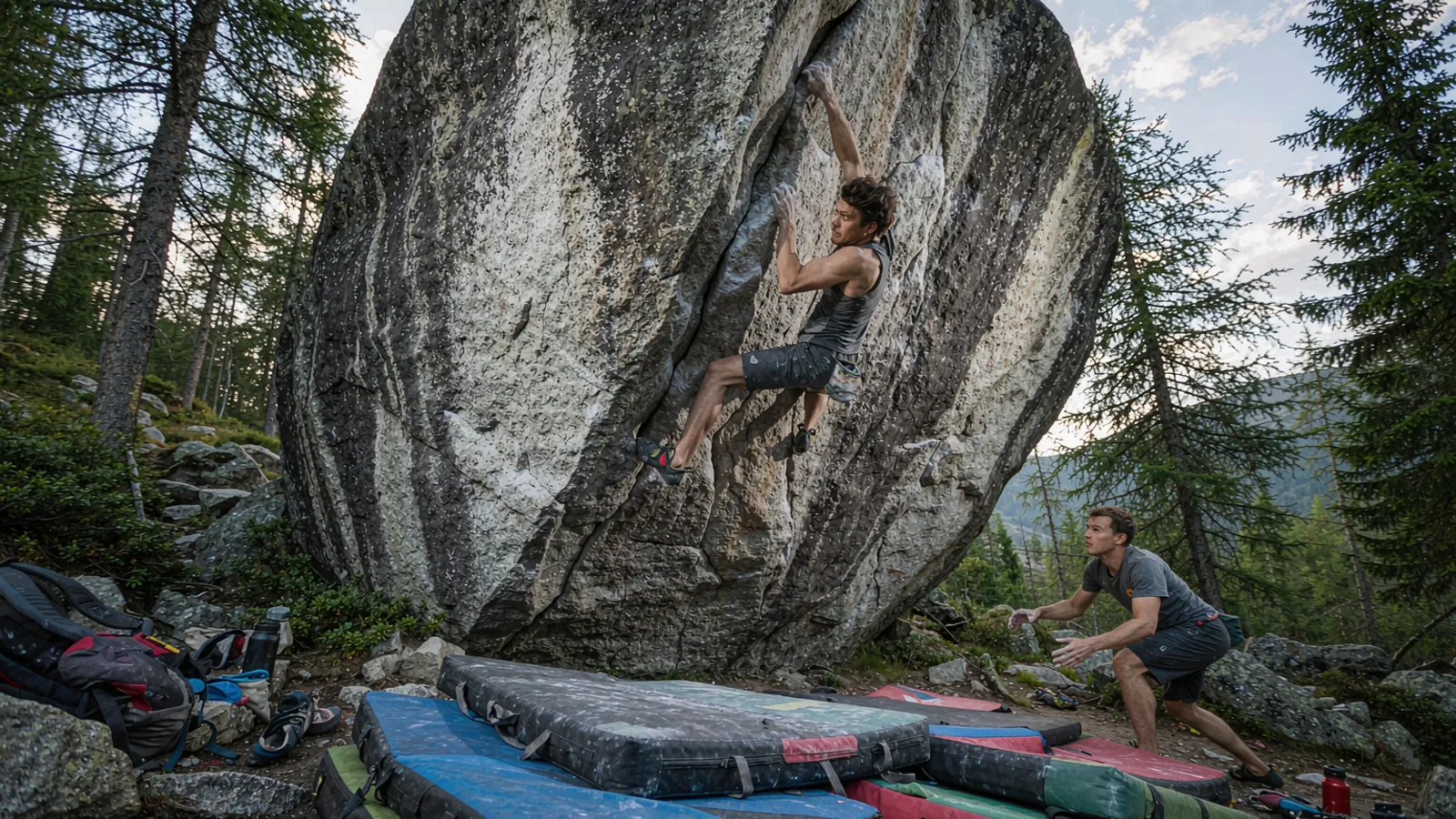
At a glance
- Foot and hand contacts work together; body position affects the forces at each contact.
- A friction model explains a relationship but cannot guarantee a hold will stay reliable.
- Grade describes climbing difficulty incompletely and does not certify the landing or descent.
Outdoor bouldering technique connects feet, hands and body position on natural rock. Edging uses a defined foothold; smearing relies more on shoe contact against a less defined surface. The movement problem also includes the landing, top-out and descent, which a climbing grade does not fully describe.
Start with the available contacts
Hands and feet interact with holds that have different shapes, directions and surface conditions. An edge, a sloping hold and a pocket do not offer the same kind of contact. The body position changes how much load reaches each point and the direction of that load.
This is why trying to pull harder with the arms does not solve every movement. A foot position or a change in where the hips sit may change the task. Learn suitable movement with coaching and low-consequence problems rather than copying a posture from a single image.
Friction is a useful model with limits
A simple dry-friction model relates available resistance to the force pressing two surfaces together and a coefficient describing their interaction. Real rock-and-shoe contact is more complicated: surface texture, moisture, wear, material and geometry matter.
Do not turn the model into a numerical guarantee for a sloper. You normally do not know a measured coefficient for the actual contact, and the model does not account for every way the hold or surface could change. Its value is explaining why contact direction and conditions matter.
Edging, smearing and balance answer different questions
REI’s movement guide distinguishes edging from smearing and describes body-position methods for maintaining balance. 3 Use these terms to describe a contact, not to prescribe one posture for every boulder.
| Movement question | What to observe on a suitable low problem |
|---|---|
| Is there a defined foothold? | Whether the contact is an edge or a broader rock surface |
| Does the foot stay where intended? | Placement accuracy and whether it changes as the body moves |
| Which direction does the hold support? | The relationship between the available contact and intended movement |
| What changes when the hips move? | Whether another contact becomes harder to maintain |
For example, a climber may repeatedly reach for a handhold while the same foot loses its position. In a coached low-consequence exercise, the useful question may be the foot contact and the movement that precedes the reach, rather than simply pulling harder. This is a hypothetical observation example, not a diagnosis of an individual move.
Separate observing a difference from proving its cause. A second attempt can differ because the contact, effort, rock condition or movement changed. A coach can help isolate a suitable task and explain why a particular adjustment fits it. A diagram of a centre of mass is a model, not a guarantee that a shoe will stay on a hold.
Before taking movement practice outdoors, review the landing-zone article. For a cold day with frequent waits between attempts, the layering guide addresses a different part of the session. More comfortable clothing does not make a poor landing acceptable, and a well-covered landing does not teach footwork.
Practise observation as well as strength
Before an attempt, identify the likely contacts and the parts of the movement you do not understand. A useful practice goal might be finding a more repeatable foot placement on an appropriate low problem, rather than reaching a harder grade by a particular month.
Ask a suitable coach or experienced local partner about movement and the area’s rock conditions. The BMC’s outdoor introduction discusses the transition from indoor activity to the wider outdoor context. 1 Do not assume that a gym grade or a familiar hold shape transfers every part of the task.
Grade leaves out important consequences
Assess the ground, possible fall directions, top-out and descent before climbing. Pads reduce some consequences but do not create a gym floor. Their placement and spotting require practical understanding. The BMC skills leaflet addresses those tasks as distinct skills. 2
There is no universally harmless bouldering height. A low fall onto an obstacle can be serious, while additional pads do not make every higher problem appropriate. Use the separate landing-zone guide to organise the questions without treating it as a substitute for instruction.
Keep access and rock condition in the decision
Follow local access information and guidance on fragile or wet rock. Different rock types and sites need different care. Avoid damaging holds or altering the landing to force a particular climb to work.
Progress is a better understanding of contact, movement and the limits of the chosen problem. A session that ends with a more controlled simple sequence or a sensible decision to choose another boulder can be more useful than a single difficult move with an uncertain exit.
Reader questions
What is the difference between edging and smearing in bouldering?
Edging uses a defined foothold with part of the shoe edge. Smearing uses contact against a less defined surface. Rock shape, condition, footwear and body position affect both; learn the practical movement on appropriate problems with coaching.
Why can an easy outdoor boulder still be inappropriate?
A grade summarises climbing difficulty imperfectly and does not certify the landing, height, top-out or descent. A physically manageable sequence can still have consequences that the group cannot suitably manage.
Sources and scope
Each reference supports the topic stated in its scope note. Worked examples are illustrative unless identified as measured results. Use current local information and the manual for your own equipment alongside appropriate practical instruction.
- BMC: outdoor bouldering for the first timeThe transition from indoor bouldering to outdoor conditions and access.
- BMC: new rock climbers skills leafletBouldering mat arrangement and spotting; use alongside practical instruction.
- REI: climbing techniques and movement terminologyEdging, smearing and balance terminology; not a site-specific outdoor climbing assessment.
Continue reading
- Bouldering Landing Zones: Crash Pads and Spotting
Assess outdoor bouldering landing zones, crash-pad gaps, changing fall directions, spotting limits and the descent before choosing a problem.
- Mountain Layering System: Base, Midlayer and Shell
Plan clothing for ascent, stops and the return. Use a downloadable layering field log and a fictional worked record to separate garment, fit and packing problems.