
Longboard Freeride: Slide Wheels, Grip and Setup
Compare longboard freeride wheel lips, contact patches and durometer. Understand slide release, grip recovery and how to evaluate a complete setup.
By ActionSportsHQ Editorial · Published · 5 min read
At a glance
- A slide changes the contact behaviour between wheel and ground; initiating it and recovering grip are separate skills.
- Wheel shape, formula, wear and the surface matter as well as hardness.
- Freeride is not automatically low risk because it is described as slower than racing.
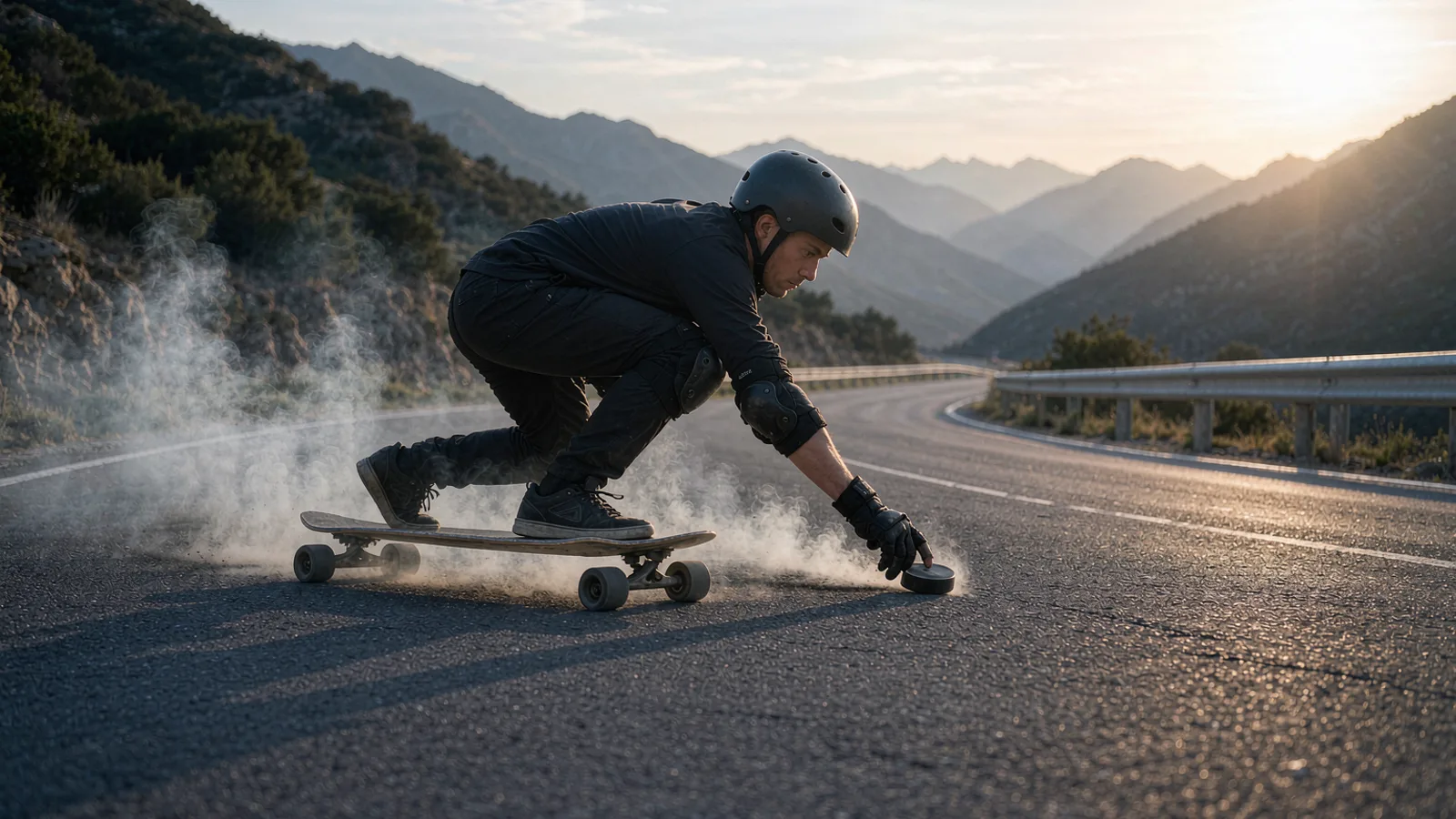
Longboard freeride centres on controlled slides and linked turns rather than a race result. A slide has three distinct parts: leaving ordinary rolling grip, managing sliding contact and returning to rolling. Wheel design can influence those transitions, but no hardness label or wheel shape teaches the rider how to control them.
What changes when a longboard slides?
In ordinary rolling, the wheel rotates as the board travels. In a slide, part of the wheel’s contact also moves sideways relative to the pavement. The direction and behaviour of the contact change. Initiation and recovery therefore deserve as much attention as the visible sideways part of the move.
Think of a turn that begins under rolling grip, becomes a slide and then hooks back into grip. The rider must manage a changing support system throughout. A long slide that finishes with an uncontrolled return is not the same skill outcome as a shorter, predictable slide. This is a conceptual description, not a movement sequence for trying it on a hill.
Compare wheel shape before relying on durometer
Orangatang’s design guide distinguishes rounded-lip, prepared-contact-surface freeride wheels from other designs. Landyachtz also describes freeride and racing wheels as serving different grip and slide objectives. 3 4 These are manufacturers’ design explanations, not an independent ranking of every wheel.
| Characteristic | What it describes | What to compare on the actual wheel |
|---|---|---|
| Durometer | A hardness designation | Formula, intended use and the maker’s explanation of that rating |
| Contact patch | The designed contact width | Width, wear and how the surface is finished |
| Lip shape | The edge profile of the wheel | Rounded or sharper edges, including how they have worn |
| Diameter | Wheel size | Deck clearance, wear and compatibility with the whole board |
| Core position | The core’s location within the wheel | The maker’s rotation guidance and permitted orientation |
The useful comparison is a set of interacting features. A harder wheel with a different shape and formula is not a controlled experiment on hardness. Equally, a wheel sold for freeride should not be assigned a universal breakaway speed. Road texture, moisture, loading and technique still change the result.
An example: two wheels with the same hardness label
Imagine two compatible wheels carrying the same durometer designation. Wheel A has a rounded lip and is described by its maker as intended for freeride. Wheel B has a different edge profile and is described as intended to retain grip for racing. The shared number does not erase those design differences.
This is a hypothetical product-reading exercise, not a test result. The defensible conclusion is that durometer alone is insufficient. To compare the products, obtain the manufacturer’s intended-use information and the complete dimensions. To compare their actual handling, a rider would also need an appropriate supervised task and comparable conditions.
The same logic applies after wear. A wheel that began with a sharp edge may no longer have that edge. Record the present condition rather than repeatedly describing a used wheel by its new-product photograph.
Check the board around the wheels
Deck, trucks, bushings, wheels and hardware form one arrangement. A larger wheel changes the clearance question. A different truck or bushing arrangement changes another part of the system. Identify the approved parts and resolve wheel contact with the deck, loose hardware or damage before riding.
Change observations one at a time when possible. If wheels, trucks and practice surface all change together, an easier-feeling session cannot establish which change caused the difference. Notes such as ‘same board, different approved wheels, dry surface’ are more informative than ‘this wheel is always safer.’
Choose a controlled place to learn slide transitions
Reliable turning, speed management and an appropriate stopping method belong before a new sliding task. Learn with a competent instructor in an authorised space with suitable surface, separation and recovery room. A public road without visible traffic is still a public road.
Local access rules are specific to the operator. Portland’s facility information is one example, not permission to use another location for freeride. 2 The skatepark planning guide explains how to observe shared lines; it does not make every park suitable for longboarding.
Use protective equipment intended for the activity and follow its fit and replacement instructions. CPSC distinguishes the scope of recreational helmet standards; one certification is not a promise against every injury. 1
Judge the exit as carefully as the slide
A useful learning note identifies the task, the control achieved and what remains inconsistent. Could the rider end the exercise predictably in the agreed area? Did surface or equipment conditions change? These questions reveal more than the longest slide or largest angle.
Freeride and downhill overlap in equipment and skills but have different objectives. Read the downhill longboarding explanation for the relationship between speed, energy and venue control. More speed is a change in consequence, not a solution to an unresolved transition.
For a specification comparison, separate wheel diameter, durometer and contact patch. A harder compound and a different profile change different parts of the comparison; preserve those variables instead of attributing every change to the printed hardness.
Reader questions
Are harder longboard wheels always easier to slide?
No. Hardness is one variable alongside urethane formula, lip shape, contact patch, finish, wear and surface conditions. Compare the intended use and complete design rather than choosing from durometer alone.
What is the difference between freeride and downhill longboarding?
Freeride often emphasises controlled slides and linked turns; downhill emphasises descending a course, with racing being one form. They share some equipment and skills, but the venue, speed and control requirements must be assessed for the actual session.
Sources and scope
Each reference supports the topic stated in its scope note. Worked examples are illustrative unless identified as measured results. Use current local information and the manual for your own equipment alongside appropriate practical instruction.
- CPSC: recreational helmet standardsActivity-specific helmet standards; no guarantee against every injury.
- Portland Parks: skateboarding facilitiesLocal facility information and the participation and etiquette pledge.
- Orangatang: longboard wheel design guideManufacturer examples of wheel lips, contact patches and freeride designs; not a universal grip test.
- Landyachtz: skateboard wheels explainedManufacturer explanation of wheel design and the distinction between freeride and race-wheel objectives.
Continue reading
- Skateboard Wheels: Diameter, Durometer and Contact Patch
Compare skateboard and longboard wheel diameter, durometer, contact-patch width and profile. Read labels accurately and check what each specification leaves out.
- Downhill Longboarding: Speed, Grip and Course Planning
Understand downhill longboarding speed, kinetic energy, aerodynamic drag and wheel grip, with a worked comparison and questions for a controlled course.
- Skatepark Etiquette: Taking Turns and Planning Lines
Learn skatepark etiquette for queues, shared lines, blind bowls and filming. Use a practical session example to choose where to wait, ride and finish.