
Beginner Wing-Foil Equipment: Board, Wing and Foil
Choose beginner wing-foil equipment as a complete system. Compare board volume and shape, foil connections, wing handling and second-hand buying checks.
By ActionSportsHQ Editorial · Published · 6 min read
At a glance
- Board volume alone does not describe stability or determine the right beginner setup.
- Match the board, foil and fasteners using their actual compatibility and assembly instructions.
- Choose equipment with an instructor and a suitable venue before relying on a professional rider’s small-board setup.
Beginner wing-foil equipment should be chosen as a complete system: board, mast and foil parts, hand-held wing, approved connections and suitable protection. Define the lesson venue and learning task with an instructor first. Board volume or front-wing area alone cannot identify a compatible, manageable first setup.
Begin by defining the learning situation with a qualified instructor. Rider experience, local conditions, available lessons and the intended water area all affect equipment choices. Manufacturer advice is useful, but advice for one product range is not a compatibility statement for every brand.
Start with the board’s whole shape
Volume describes how much water a board can displace when immersed. It is relevant to flotation, but it does not completely describe stability. Width, outline, length, distribution of volume and construction also affect how a board behaves on the water.
A low-volume board used by an expert can require skills that a new learner has not developed. Duotone’s equipment guidance explicitly distinguishes beginner choices from small boards used by highly experienced riders. 1 There is no single number in this article that turns body weight into the correct board for every person.
Ask how the proposed board works for the initial learning exercises at your school. Some early work may use a different platform from the one intended for later foiling. A setup should support the stage being taught, rather than demand that the learner skip it.
Treat the foil as several compatible parts
A hydrofoil usually includes a mast and lifting surfaces, with a connection system that may also use a fuselage and stabiliser. Exact designs vary. The mounting interface on the board must suit the foil, and the foil’s parts must be approved for use together.
Do not assume that hardware is interchangeable because a bolt can be threaded into a hole. Thread size, length, material, engagement and the installation procedure all matter. A fastener that bottoms out can give a false impression of clamping. Follow the actual manuals and have an uncertain assembly checked by someone competent with the system.
Surface area alone is not enough to compare two front wings. Shape and design affect speed range and handling. Rather than selecting the largest or most advanced-looking part, ask the instructor or supplier to explain why the entire foil is suitable for the learning objective.
Choose a wing for handling as well as area
Wing size affects the available force, but rider mass, wind conditions, wing design and experience are also relevant. A larger wing is not a universal solution to a difficult session. It can introduce handling challenges, especially when the tips approach the water or the rider is learning to control it.
Look at the handle or boom arrangement, the inflation instructions and the permitted pressure. Use the instructions for that exact model rather than transferring a pressure from another wing. Check valves, seams and inflation equipment before use. A convenient-looking adjustment should not substitute for manufacturer guidance.
Ask how the school selects wings for its students and changing conditions. Rental or lesson equipment can help establish what is suitable before committing to a full personal setup.
Match protection and connection systems to the venue
The submerged foil can injure a rider or other water users. Duotone’s safety material emphasises protection and awareness of the foil, including beginner board-leash advice. 2 That advice should be considered with the instructor, the equipment manual and the venue; it is not a universal leash arrangement for every body of moving water.
Check local flotation requirements and the suitability of any vest for the activity. An impact vest and an approved flotation device are not automatically the same product. Helmet selection also depends on the activity and the manufacturer’s intended use.
A leash introduces its own connection and entanglement considerations. Do not invent an attachment method or transfer rules from surfing, kiting or whitewater without checking whether they apply. Learn the actual release and emergency procedures during supervised instruction.
Assemble a compatibility record
| Part of the setup | Information worth keeping |
|---|---|
| Board | Model, mounting interface, intended use and inspection instructions |
| Foil | Approved mast, wings and connections for the selected system |
| Fasteners | Correct part identifiers and the manufacturer’s installation procedure |
| Hand-held wing | Model, inflation instructions and damage checks |
| Protection and leashes | Intended use, fit and venue-specific instruction |
The record is especially useful with second-hand equipment. A seller’s description that something “works together” is not the same as a manufacturer’s compatibility statement. Missing manuals or unknown modifications are questions to resolve before using the setup.
A second-hand package: separate value from missing information
Imagine a used package advertised with a generous board volume and a large front wing. The asking price may look attractive, but the listing omits the mast-to-fuselage interface, rear-wing model and original fastener information. The two headline dimensions cannot answer those omissions. This is a hypothetical buying example, not a product review.
Ask for exact model and generation identifiers, current manuals, approved component combinations and the history of damage or repair. Inspecting a photo is not equivalent to establishing condition. Resolve unknowns with an appropriately knowledgeable supplier or instructor before purchase and use.
Duotone’s foil information discusses geometry and interfaces as parts of the whole system. 3 Its product-specific advice illustrates why a generic claim that ‘all foil parts fit’ is insufficient; it does not approve mixed parts from other ranges.
A useful outcome of an introductory lesson is a description of what equipment supported the actual task, rather than an immediate shopping list copied from an expert. The wing-foiling explanation separates non-foiling control from height control, while hydrofoil mechanics explains the component roles. Use that vocabulary to ask more precise questions about a proposed package.
Plan the first sessions before changing the equipment
A suitable lesson venue includes the space, depth and conditions required by the school and the actual foil. A familiar shoreline can still contain shallow areas or obstacles. Check access, other users and the route back; equipment selection cannot compensate for an unsuitable learning site.
If a session is difficult, separate the possible causes: conditions, task, technique, fit or equipment. Changing several components at once makes it hard to understand the result. Use feedback from the instructor and keep notes about the actual setup rather than attributing every problem to front-wing size.
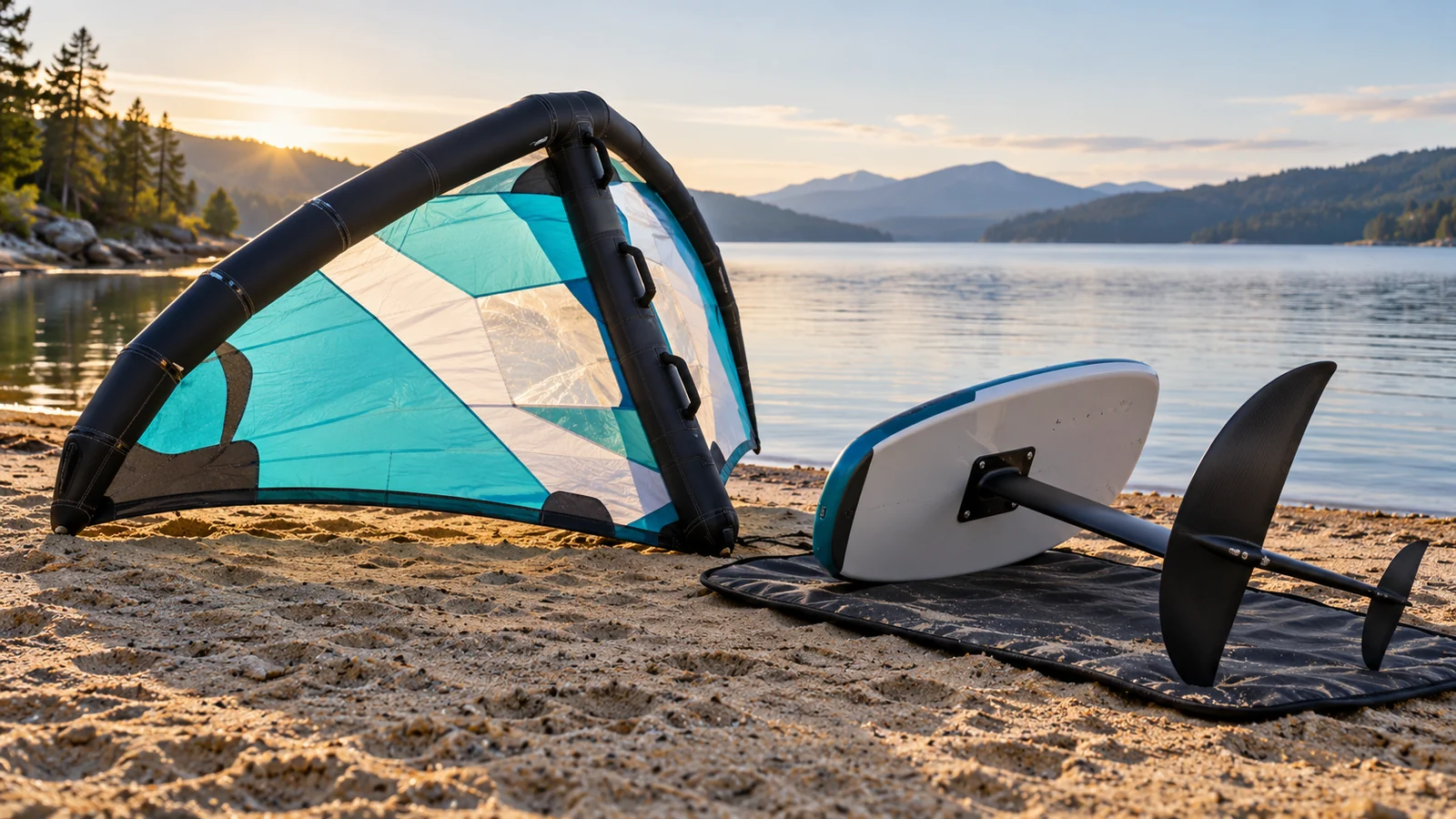
The cover illustrates the difference between a hand-held wing and a foil board. It does not specify a rigging arrangement or prove that the depicted parts are compatible. Your own equipment record and current manuals are the references for assembly.
Reader questions
How much board volume does a beginner wing foiler need?
There is no single body-weight formula that establishes the right board. Shape, width, volume distribution, experience and lesson conditions also matter. Ask the school to explain how a particular board supports the early exercises before buying.
Can foil parts from different brands or generations be mixed?
Only where the relevant manufacturers approve the complete interfaces and parts. Matching holes or a bolt that threads in does not prove correct engagement, clamping or compatibility. Keep model identifiers and installation instructions with the setup.
Sources and scope
Each reference supports the topic stated in its scope note. Worked examples are illustrative unless identified as measured results. Use current local information and the manual for your own equipment alongside appropriate practical instruction.
- Duotone: choosing wing-foiling equipmentManufacturer discussion of equipment selection and beginner suitability.
- Duotone: wing-foiling safety measuresFoil injury awareness, protective equipment and beginner board-leash advice.
- Duotone: foil design parametersManufacturer discussion of front wings, aspect ratio, mast and fuselage geometry; published sizes are not universal prescriptions.
Continue reading
- Wing Foiling Explained: Wing Power, Foil Lift and Control
Learn how wing foiling combines a hand-held wing with a hydrofoil. Compare it with kitesurfing and windsurfing, and understand the stages of learning.
- Hydrofoil Surfing Explained: Lift, Pitch and Foil Parts
Learn how a surf hydrofoil generates lift, what the mast and wings do, and why pitch, water flow and the complete setup matter more than area alone.
- How to Read a Surf Forecast: Height, Period and Direction
Decode surf forecast labels with worked component comparisons. Separate combined seas, swell period and direction, then keep a record using the Swell Component Lab.