
First Tandem Skydive: What to Expect and Ask Beforehand
Prepare for your first tandem skydive with questions about eligibility, clothing, timing, weather delays, instructor briefings and what happens afterwards.
By ActionSportsHQ Editorial · Published · 6 min read
At a glance
- A tandem jump pairs a student with an appropriately qualified instructor using a tandem system.
- The operator must assess eligibility and provide the actual briefing; internet instructions cannot replace it.
- Completing a tandem experience does not by itself qualify someone to skydive independently.
For a first tandem skydive, confirm the operator, eligibility requirements, clothing, arrival arrangements and weather-delay policy before booking. On the day, a qualified instructor fits and checks the tandem system and gives the briefing for your jump. A short advertised freefall duration is only one part of the visit, not the time to allow for the whole experience.
USPA describes tandem alongside other first-jump methods, including Accelerated Freefall and other structured training routes. They involve different responsibilities and instruction. Do not book one method while assuming it is interchangeable with another. 1
Ask what is included before booking
Confirm the method, the operator’s requirements and the arrangements for the day. Ask how the instructor’s qualification is established, what organisation or rules govern the operation and how the briefing is delivered. A website photograph of a parachute does not answer those questions.
Discuss the expected arrival time, waiting arrangements, cancellation policy and the treatment of weather delays. The advertised flight or freefall duration should not be interpreted as the total time needed at the centre. Operations can be delayed for reasons that are not visible from the waiting room.
If video is offered, ask who operates the camera and what is included. Do not assume a personal camera can be carried just because the centre sells footage. Equipment and participation arrangements belong to the operator’s procedures.
Resolve eligibility with the operator
Age, size, medical fitness and other eligibility requirements depend on the governing rules, the equipment and the operator’s policies. Ask directly and provide accurate information. This article does not provide a universal weight limit or determine whether a medical condition is compatible with a jump.
USPA’s Basic Safety Requirements include medical-fitness and instructional requirements in their jurisdictional context. 2 If you have a relevant health concern, discuss it with the operator and an appropriate clinician rather than asking a booking calendar to assess it.
Do not hide a limitation because you have already paid or travelled. The point of early questions is to resolve suitability before the activity, including whether the necessary explanation and support can be provided.
Treat the briefing as the central preparation
Listen to the instructions for that jump, with that instructor and that equipment. Ask about the aircraft phase, the student’s expected actions, communication and landing preparation. If a phrase or demonstration is unclear, ask for it to be explained again before the activity proceeds.
The actual procedures should be demonstrated and practised under the operator’s direction. This article intentionally does not publish a universal body-position or emergency-action sequence. Instructions depend on the system and the phase of the jump, and conflicting internet advice can make a student less predictable.
Tell the instructor if you have difficulty understanding or carrying out an instruction. An unresolved question is important information. It should not be concealed by nodding along because the group appears ready to leave.
Leave harness fitting and checks to the qualified staff
A tandem system is not a generic backpack. Its configuration, fitting and checks are equipment-specific tasks managed by the qualified operation. Do not loosen, move or reconfigure an adjustment because it seems unfamiliar; raise the concern with the instructor.
Wear the clothing and footwear specified by the operator. Ask about glasses, loose objects and jewellery rather than assuming rules from another centre apply. Keep personal belongings where directed and do not introduce unapproved equipment into the plan.
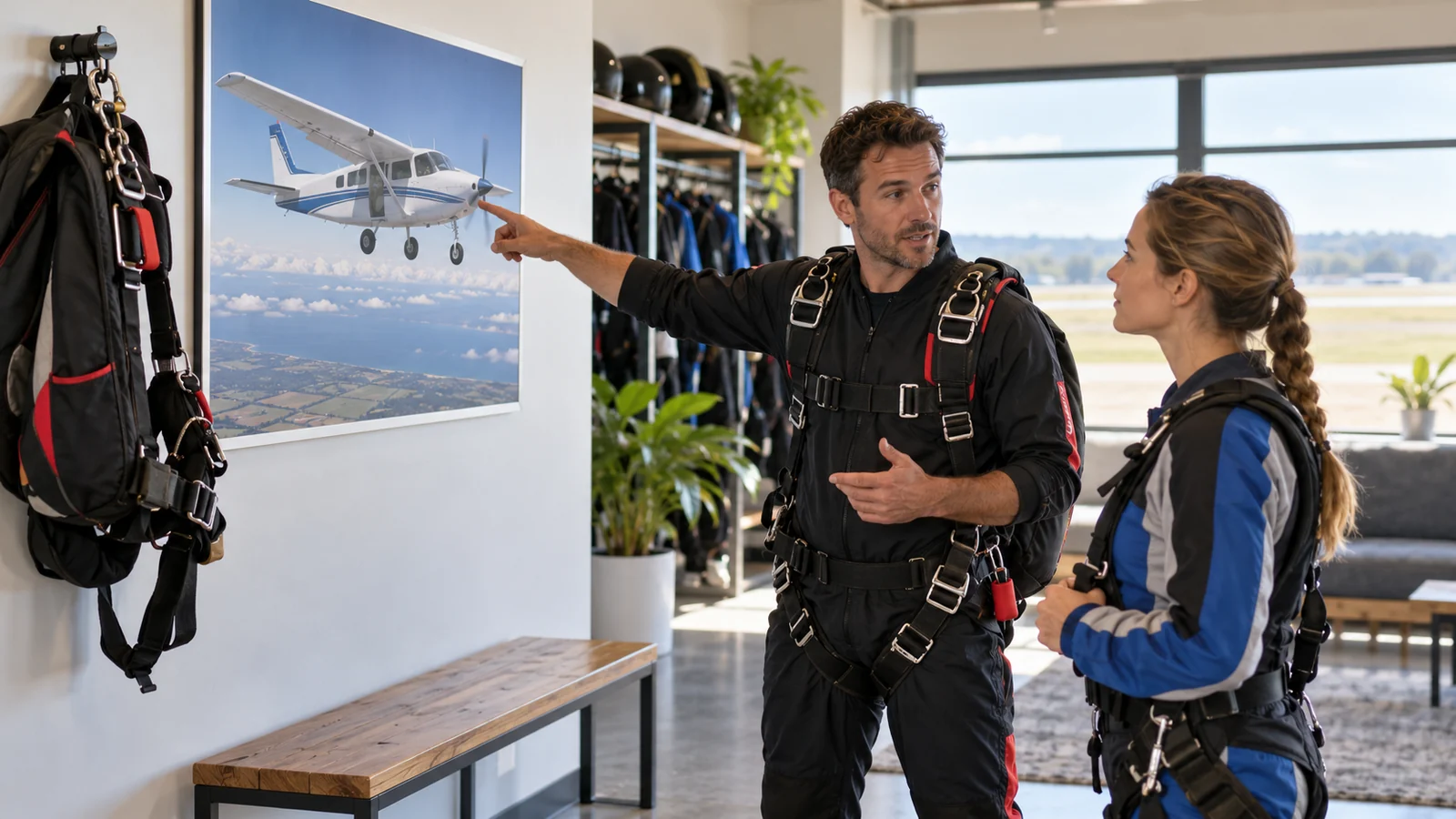
The cover is an editorial illustration of a discussion. It does not demonstrate harness fit, attachment points or a rig inspection. The equipment seen in an illustration cannot establish that a real setup is correctly configured.
Expect the plan to change with conditions
Skydiving uses both the aircraft environment and the landing area. Weather and operational checks are therefore part of the activity, not a customer inconvenience to override. A clear view from the ground does not describe every relevant condition aloft.
A postponement or cancellation is a valid operational decision. Payment, travel distance and excitement do not make a marginal condition more suitable. Ask in advance how a delay is handled so that it does not become pressure to proceed on the day.
A useful set of questions for the centre
| Before arrival | During the actual briefing |
|---|---|
| Which jump method am I booking? | What actions are expected from me in each phase? |
| Which eligibility and clothing requirements apply? | How should I communicate an unclear instruction or concern? |
| How are qualifications and operating rules established? | What will be practised before boarding? |
| What happens if conditions cause a delay? | Which items and movements are permitted? |
The table is a communication aid. It does not replace any required paperwork, fitting or operator checklist. Keep the answers tied to the centre where the jump will happen rather than transferring them to a different operation later.
Plan the visit in stages rather than around the freefall clip
A practical booking note separates arrival and check-in, eligibility questions, fitting and briefing, operational waiting, the jump and what is included afterwards. Ask the operator about the total appointment arrangements. Do not add a universal duration to each stage: aircraft operations, weather and the programme can change the timing.
For example, a visitor may have a short video package in mind but a fixed appointment elsewhere immediately afterwards. The useful question is whether the centre can accommodate that constraint, not whether the advertised freefall duration sounds short. This is a hypothetical scheduling example, not a promise about a particular operation.
Record unresolved questions before travelling: whether glasses can be accommodated, the required footwear, which personal items are permitted and how a postponement is handled. Let qualified staff address fitting and operating questions with the actual equipment. Answers remembered from a different centre are not automatically transferable.
USPA presents tandem as one introductory method alongside other student pathways. 1 The skydiving basics guide explains the different phases without supplying a jump procedure. If you decide to continue after a tandem, discuss the relevant student programme and how your experience is recorded, rather than assuming a completed booking equals an independent licence.
Understand what happens after the experience
A completed tandem jump does not on its own qualify a person for independent skydiving. If the experience leads to further interest, discuss the appropriate structured student programme and how previous jumps may be recognised within it. USPA’s Integrated Student Program introduction distinguishes training methods and learning responsibilities. 3
Ask what the next stage actually requires: ground instruction, supervised practice and demonstrated skills, not simply another purchase. Treat progression as an education plan with the relevant instructors. The first experience can introduce the sport without pretending that the responsibility of an independent jumper has already been learned.
Reader questions
How long should I allow for a first tandem skydive?
Ask the actual operator about the total visit, including arrival, eligibility checks, fitting, briefing, waiting and weather delays. The advertised freefall time is not the appointment length, and a fixed finish cannot be inferred from a short video clip.
What should I wear or bring for a tandem jump?
Follow the operator's clothing and footwear instructions and ask about glasses, jewellery and loose items before arrival. Do not introduce an unapproved camera or change harness adjustments yourself. Raise fitting or instruction concerns with the qualified staff.
Sources and scope
Each reference supports the topic stated in its scope note. Worked examples are illustrative unless identified as measured results. Use current local information and the manual for your own equipment alongside appropriate practical instruction.
- USPA: your first skydiveTandem and other first-jump methods, preparation and training context.
- USPA: Basic Safety RequirementsUSPA medical-fitness, student and instructional requirements in their actual operating context.
- USPA: Integrated Student Program introductionThe scope of structured student instruction and the distinction between training methods.
Continue reading
- Skydiving Basics: Freefall, Parachutes and Training
Understand skydiving freefall, drag, parachute deployment and canopy flight. Compare tandem, AFF and other student methods before choosing training.
- Wingsuit Flying: Requirements, Glide and Training
Check USPA wingsuit requirements and first-flight training context. Understand glide ratio, suit selection and why aircraft skydives differ from BASE.