
Bouldering Landing Zones: Crash Pads and Spotting
Assess outdoor bouldering landing zones, crash-pad gaps, changing fall directions, spotting limits and the descent before choosing a problem.
By ActionSportsHQ Editorial · Published · 6 min read
At a glance
- Assess the landing and descent before deciding to climb, not after reaching the crux.
- Pad coverage must follow possible fall directions; more pads do not automatically solve a poor landing.
- A spotter helps manage a fall but is not a human belay and cannot make every problem suitable.
A bouldering landing zone includes the ground beneath and beyond every plausible fall position, not just the space directly below the starting holds. Assess it alongside the top-out and descent before climbing. Crash pads and competent spotting can reduce some consequences but cannot turn every outdoor problem into a suitable objective.
Assess the entire problem from the ground, including the descent. The useful question is not simply “where will I drop?” but “where could I go if a foot slips, a hold breaks, or the movement turns my body?” The BMC’s bouldering skills material describes pad arrangement and spotting as practical skills to learn, not interchangeable substitutes for judgment. 1
Read the fall line before placing the pads
Identify the starting position, traversing sections, higher moves and the top-out. A climb that shifts sideways may have several different landing areas. A swing from an overhang can change the direction of a fall; a straight vertical projection from one handhold is not a complete picture.
Look for rocks, gaps, sloping ground and obstacles around the possible landing area. Check what lies beyond the pad edges. A landing that appears covered from one angle may still allow a rolling or sideways fall toward another hazard.
The decision can be to choose another problem. Pads and spotters do not have to solve every landing you encounter. In particular, height, an exposed top or a difficult descent can make the overall objective inappropriate even when the first moves are comfortable.
Think in terms of usable coverage
Position pads according to the manufacturer’s orientation and the landing you have assessed. Their shapes, hinges, straps and foam constructions differ. Do not assume that stacking pads always makes a landing better; it can create edges, movement or an uneven surface.
Inspect gaps and the relationship between adjacent pads. Keep carrying straps and unrelated equipment out of places where a climber or spotter may land or move. Recheck after pads have shifted. An arrangement that worked for the starting move may not cover the upper or traversing part.
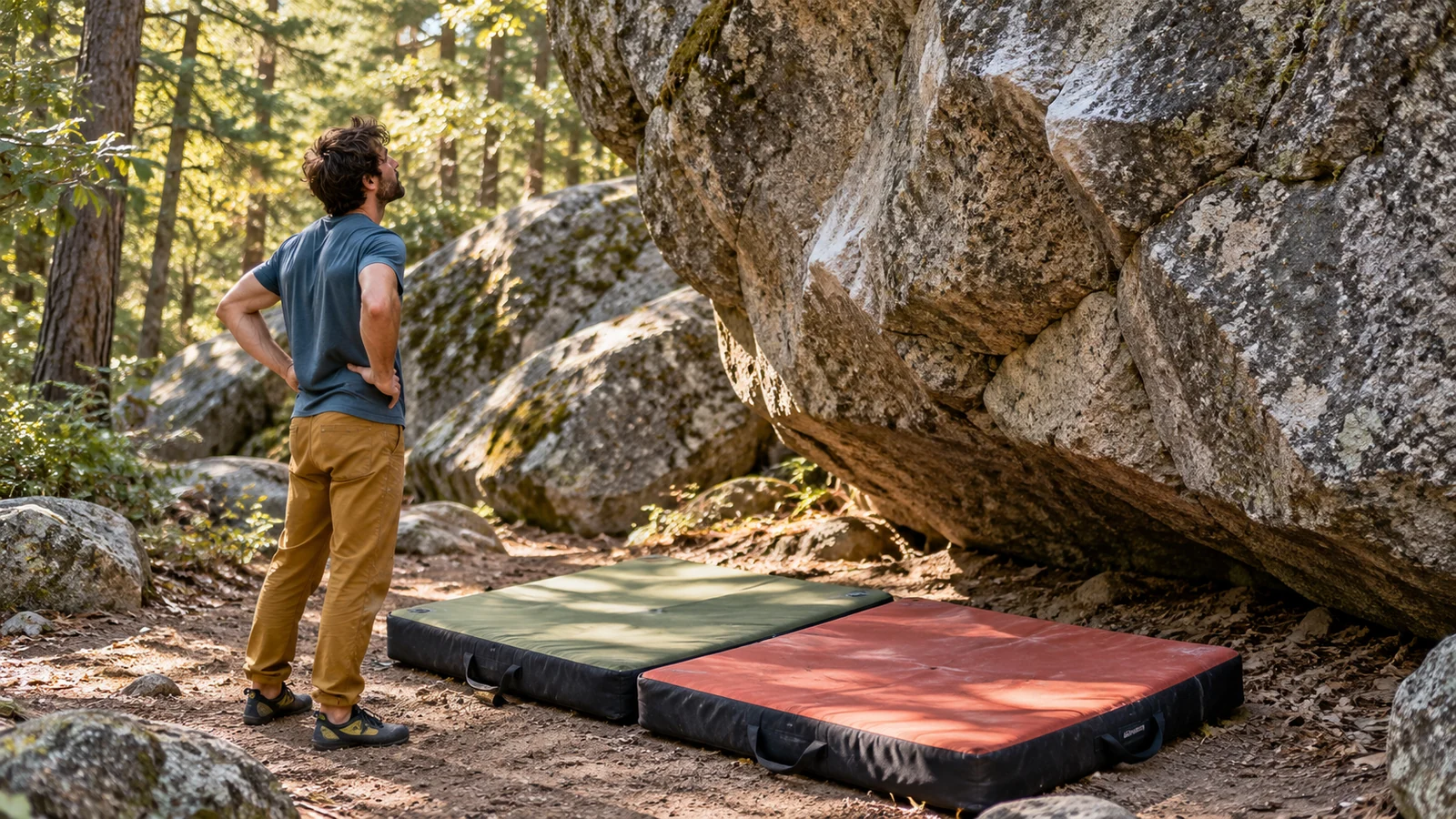
The cover illustration shows a simple level setup for context. It is not a diagram of a suitable landing for a real climb, and the correct arrangement cannot be determined from a generic image. Practical instruction should include assessing the particular ground and changing pad placement when needed.
Discuss spotting before the attempt
A spotter’s role is not to catch the entire weight of a falling climber. Spotting concerns helping direct the fall and protecting vulnerable areas within the spotter’s ability and the situation. It exposes the spotter to risk too. The BMC describes spotting as a skill involving responsibility and possible harm. 1
Agree on what the climber intends to attempt, the likely direction of a fall and whether the spotter is willing and able to help. A person standing nearby while looking at a phone is not an available spotter. A climber should not start a move assuming someone has silently taken responsibility for it.
Learn technique in a suitable setting from someone competent to teach it. This article deliberately does not give hand-placement instructions for all falls. Body positions and consequences differ too much for a universal paragraph to be reliable.
The top-out and descent are part of the problem
Before leaving the ground, establish how the climb ends and how to return. The hardest or most exposed movement may be above the last obvious handhold. A damp rounded top, loose material or an unseen drop behind the boulder can change the assessment.
A route grade does not describe all of that. Two problems of the same climbing difficulty can have very different landing and descent consequences. A sequence well within someone’s strength can still be an unsuitable outdoor objective.
If the descent cannot be assessed, treat that as an unanswered planning question. Do not rely on the hope that there must be an easy way down. An experienced local partner or instructor may help identify suitable alternatives and explain local conditions.
Example: a traverse changes the landing question
Imagine a low start that traverses sideways before a higher finish. Pads centred below the first move may look generous from the start but leave the later position outside the usable coverage. Counting the pads does not reveal that mismatch. This is a hypothetical planning example, not a pad-placement diagram.
Trace the intended movement from the ground and discuss how possible fall directions change. Include the space a spotter would need to move without stepping into a gap or another hazard. If coverage would require coordination the group cannot manage, selecting a different problem is a valid answer.
The finish introduces another question: can the descent be inspected before the attempt? An easy-looking top-out does not identify what lies behind the boulder. The assessment must continue past the final difficult hand move.
Use the outdoor bouldering movement guide for the distinction between physical difficulty and consequence. The mountain clothing guide covers waiting between attempts, but additional clothing or additional pads do not substitute for resolving an unsuitable landing. The objective is a complete problem the group can understand, not a larger pile of equipment.
Make a decision at the ground, not at the crux
| Question | Why it matters |
|---|---|
| Where can the body travel if the move fails? | Pad placement must consider movement, not just height |
| Is the ground beneath and beyond the pads acceptable? | Pads do not remove all edges or terrain hazards |
| Can the group manage the landing as the climb changes? | Coverage and spotting may need reassessment |
| Is the descent understood? | Finishing the climbing moves is not the end of the outing |
These are conversation prompts rather than a scoring system. A collection of favourable answers does not guarantee an injury-free fall. If one critical question remains unresolved, use a different problem or seek instruction instead of adding it to a list of things to improvise later.
Protect the site as well as the climber
Follow access information and local guidance about fragile ground, rock conditions, brushing and wet rock. Rock types do not respond identically to moisture, so do not turn one area’s practice into a rule for every area. The BMC’s outdoor introduction is a useful starting point for understanding the differences from indoor climbing. 2
Use established paths where appropriate and remove litter. Do not change the landing by cutting vegetation, moving significant natural features or damaging the site without legitimate permission. A better preparation habit is to choose a problem the existing environment and the group’s skills can support.
Reader questions
How many crash pads do I need for outdoor bouldering?
There is no number that establishes suitability on its own. Usable coverage depends on fall directions, gaps, ground hazards, pad construction and how the climb changes. Inspect the full problem and learn pad management through suitable practical instruction.
Is spotting the same as catching a falling climber?
No. Spotting is a practical skill for helping manage a fall within limits, not a human belay. Discuss the role before an attempt, consider the spotter's own exposure and do not assume a nearby person can or has agreed to provide it.
Sources and scope
Each reference supports the topic stated in its scope note. Worked examples are illustrative unless identified as measured results. Use current local information and the manual for your own equipment alongside appropriate practical instruction.
- BMC: new rock climbers skills leafletBouldering mat arrangement and spotting; use alongside practical instruction.
- BMC: outdoor bouldering for the first timeThe transition from indoor bouldering to outdoor conditions and access.
Continue reading
- Outdoor Bouldering Technique: Footwork and Body Position
Understand outdoor bouldering footwork, edging, smearing and body position. Connect movement choices with landing, top-out and descent assessment.
- Mountain Layering System: Base, Midlayer and Shell
Plan clothing for ascent, stops and the return. Use a downloadable layering field log and a fictional worked record to separate garment, fit and packing problems.
- Parkour Vaults: Obstacle Assessment and Progression
Understand parkour vault planning through obstacle shape, hand support, approach and landing space. Compare training conditions before choosing a movement.