
Ice Climbing Equipment: Tools, Crampons and Protection
Understand ice-climbing tools, boot-crampon compatibility and protection roles. Compare equipment questions without treating ice colour as a strength test.
By ActionSportsHQ Editorial · Published · 5 min read
At a glance
- An ice-tool placement is part of movement; it is not automatically a protection anchor.
- Colour alone cannot establish the strength or reliability of ice.
- Tools, crampons, boots and the protection system require activity-specific instruction and compatible equipment.
Ice climbing uses technical tools and crampons for movement, alongside a separately designed protection system and winter route plan. Equipment choice starts with the intended activity and compatible components. A tool placement, a crampon point pattern or the colour of the ice does not by itself establish a reliable anchor or a suitable route.
Separate movement support from fall protection
Technical tools and crampons provide contacts used while climbing. A rope and correctly designed protection system have a different purpose. Do not assume that a tool used successfully for movement is an appropriate anchor for another load.
Equipment is specialised. Petzl’s current ice-axe overview distinguishes products and intended activities; the names do not make every tool suitable for every technique. 1 Follow the exact product instructions, including compatibility and inspection requirements.
The appearance of ice is incomplete information
Ice can vary within a route and change with weather. Water, structure, attachment to the underlying terrain and recent conditions can matter. A colour description such as “blue ice is safe” omits too much information to support a climbing decision.
Likewise, a sound or one placement should not be turned into a universal strength test. Learning to interpret the relevant conditions belongs in appropriate winter instruction and experience. This article does not supply a minimum ice thickness or an anchor-building recipe.
Compatibility includes the boots and crampons
A crampon attachment must suit the boot and the maker’s specified system. A component that appears to stay on while standing may still be incompatible. Tool accessories, tethers and leashes also have product-specific uses and limits; there is no rule that every modern technical ice tool needs a wrist leash.
Inspect sharp components, fasteners and wear according to the manufacturer. Pack and transport them so that points do not damage clothing, rope or other equipment. Resolve an uncertain assembly before the outing rather than treating the first climb as a fitting test.
Front-point configuration and boot attachment are separate choices
Petzl’s DART family illustrates the distinction: its documentation describes configurable front points as well as specific binding components and compatibility information. 4 Selecting a point layout does not resolve whether the crampon correctly fits a particular boot. Neither does a boot attachment establish that every front-point arrangement suits the intended task.
| Equipment topic | What to identify | What it does not establish |
|---|---|---|
| Ice tool | Exact model, intended activity and technical notice | Reliability of a particular placement |
| Front points | Approved configuration and current condition | Suitability for every ice or mixed route |
| Boot attachment | Boot shape, binding components and the prescribed fit check | Compatibility based only on whether it stays on while standing |
| Protection system | Relevant equipment, skills and route context | An anchor from the success of a movement placement |
A useful pre-course question is ‘Which boot and crampon combinations will the provider check?’ That is more precise than asking whether any rigid-looking boot is acceptable. Bring the actual model information and identify changes made to second-hand equipment. Assembly and adjustment must follow the manufacturer’s notice and qualified instruction.
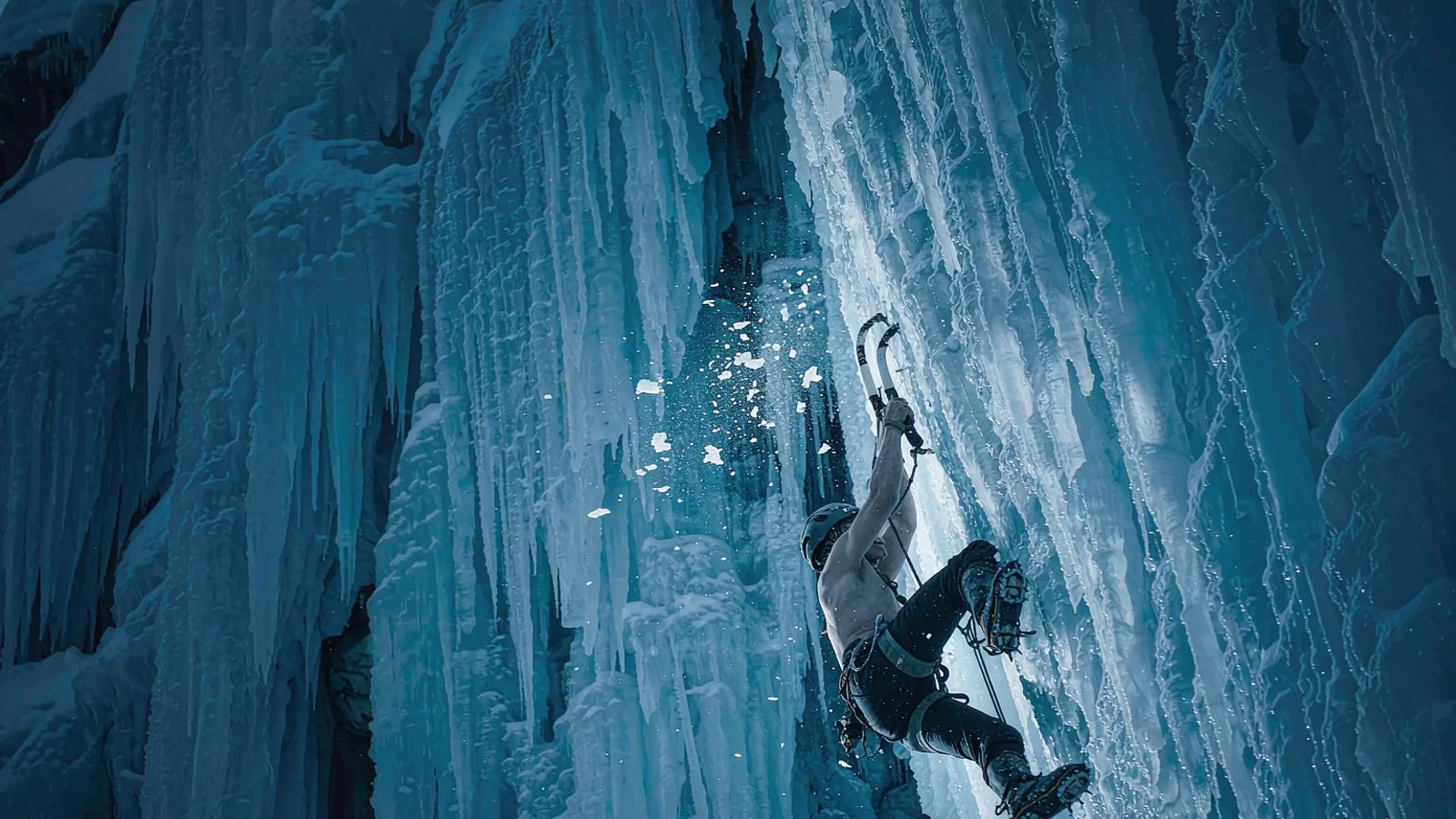
The same separation helps interpret an illustration: a climber holding two tools tells you the general activity, but not the condition of the ice, the complete protection arrangement or equipment compatibility. For the approach and a stationary partner’s needs, use the mountain clothing-system guide. If the approach crosses snow terrain, the forecast-reading article provides a separate planning framework rather than an ice-quality test.
Begin with suitable supervised instruction
A competent instructor can select a controlled setting and teach movement, protection context and communication together. REI’s introduction distinguishes movement, tools and protection as different parts of learning to climb ice. 2 Completing an introductory session is not an automatic qualification to lead an unfamiliar route.
A progression should depend on demonstrated skill and the actual conditions. It should not promise that an ice grade becomes suitable after a set number of weeks. Climbers and partners need enough shared understanding to recognise when the planned task is beyond their current preparation.
Winter preparation continues off the ice
Include the approach, waiting periods and descent in the clothing and route plan. An active climber and a stationary partner have different work rates. Cold and wet exposure can become consequential beyond ordinary discomfort; the National Park Service’s prevention guidance is relevant to the wider outing. 3
Discuss falling debris, the positions of others and the means of returning before climbing. A good objective is one the group can assess and manage in the current environment, not a line selected from an attractive photograph of a frozen waterfall.
Reader questions
Is a technical ice tool the same as an anchor?
No. A tool used for movement and a protection anchor have different purposes and loading questions. A successful movement placement does not verify an anchor. Protection and anchor skills require the relevant equipment instructions and specialist practical training.
Can ice colour tell me whether a climb is suitable?
Colour alone cannot establish ice strength, attachment, internal structure or how conditions have changed. Assessment belongs with appropriate winter-climbing instruction and current local knowledge, including the approach, overhead hazards and descent.
Sources and scope
Each reference supports the topic stated in its scope note. Worked examples are illustrative unless identified as measured results. Use current local information and the manual for your own equipment alongside appropriate practical instruction.
- Petzl: 2026 ice-axe equipment overviewManufacturer examples of technical axes and their intended activities, not a placement or anchor procedure.
- REI: ice-climbing equipment and learning contextMovement, tools and protection as distinct parts of ice climbing; current manuals and practical instruction take priority.
- National Park Service: hypothermia preventionCold and wet exposure, clothing choices and prevention in mountain recreation.
- Petzl: DART crampon configurationsOne technical crampon family with configurable front points and binding components; consult the actual technical notice.
Continue reading
- Mountain Layering System: Base, Midlayer and Shell
Plan clothing for ascent, stops and the return. Use a downloadable layering field log and a fictional worked record to separate garment, fit and packing problems.
- Outdoor Bouldering Technique: Footwork and Body Position
Understand outdoor bouldering footwork, edging, smearing and body position. Connect movement choices with landing, top-out and descent assessment.
- How to Read an Avalanche Forecast and Danger Rating
Read avalanche forecast regions, validity, danger levels, elevation bands and aspects. Use a worked bulletin example to connect problems with route questions.