
Highlining Explained: Balance, Tension and System Limits
Understand how a highline moves, why sag and tension interact, and how backups, clearance and rescue planning belong to a complete specialist system.
By ActionSportsHQ Editorial · Published · 5 min read
At a glance
- A highline is a complete safety-critical system, not a normal slackline placed higher.
- Tension and geometry interact; a breaking-strength label alone cannot validate a rig.
- Rigging, connection checks and rescue planning require specialist knowledge and suitable supervision.
Highlining places a slackline above a consequential drop and adds a specialist connection, backup and rescue context. The webbing moves under the participant, while its geometry affects the forces in the system. Walking a low slackline, reading a breaking-strength label or adding a second line does not by itself establish a suitable highline arrangement.
Why the line moves
A slackline deforms under load and can move in several directions. The participant’s motion changes the loading, and the line’s response changes the balancing task. That makes it different from standing on a rigid beam.
A person who can walk a low ground line has learned something useful about balance, but highlining adds connection, exposure and system-management questions. Ground performance is not proof of competent rigging or readiness for a particular highline.
Geometry affects forces
In a simplified static model, supporting a load with a line at a shallower angle can require greater tension in the line. Real systems also experience movement, stretch and dynamic loading. This explains why “tighter is always safer” is not a reliable rule.
A breaking-strength label describes a component under defined conditions. It is not the working limit of every assembled system, and it does not account for all installation, wear and compatibility questions. This article deliberately gives no universal line-tension, anchor-load or span table.
Redundancy must belong to the complete design
The International Slackline Association publishes specialist safety resources and highline standards. 1 Those materials address a wider system than a single piece of webbing. A backup only helps when its design, connections and possible failure interactions are correctly understood.
Do not assemble a highline by collecting isolated tips about bolts, knots or leashes. Specialist instruction and an experienced, accountable rigging group are necessary to assess the actual site and system. A generic climbing-anchor standard does not by itself validate an entire highline.
Backups, clearance and rescue solve different problems
The ISA’s highline overview discusses suitable systems and the clearance implications of a backup taking load. 3 The principle is that the backup’s presence cannot be judged independently of the geometry and what happens if another part fails. This article does not specify dimensions or assembly methods.
| System question | What needs to be understood by the qualified group |
|---|---|
| Suitability | Whether each component and its connections are intended for the use |
| Failure interaction | Whether a failure can affect more than one part of the arrangement |
| Clearance | Where the participant and loaded system could move |
| Inspection | Identity, condition and relevant use history of components |
| Rescue | How assistance can be provided at that particular span |
Imagine a mainline that has visible space beneath it, with a backup whose loaded position has not been assessed. The unloaded photograph cannot establish where the participant would be after a failure. The unanswered question is not resolved by counting two strands. This hypothetical example illustrates a system question, not a method for calculating or accepting clearance.
Likewise, a leash provides a connection role but is not itself a complete rescue plan. The ability to reach, communicate with and recover a participant depends on the whole span, location and group’s specialist skills. These questions belong with an experienced, accountable rigging group and current technical requirements.
The outdoor bouldering guide makes a related distinction between movement difficulty and consequence; its techniques do not transfer into highline rigging. The mountain layering guide can help consider exposed waiting periods, alongside the activity’s specialist equipment and rescue needs.
Inspect with the material and history in mind
Webbing condition and lifespan depend on the material, use and manufacturer guidance. The ISA’s webbing-life discussion makes those distinctions rather than assigning one lifespan to every line. 2 A visible nick should not be translated into a precise percentage of remaining strength without an appropriate basis.
Keep component identification and inspection history with the rigging records. Unknown use, unexplained damage or an uncertain connection should be resolved before participation. A bounce test is not a substitute for a competent assessment.
Participation needs a rescue plan
An experienced group must address access, connection checks, communication and what happens if someone cannot return under their own power. That plan must fit the actual span and site. A leash is not a complete rescue system, and an attractive location does not answer how assistance would be provided.
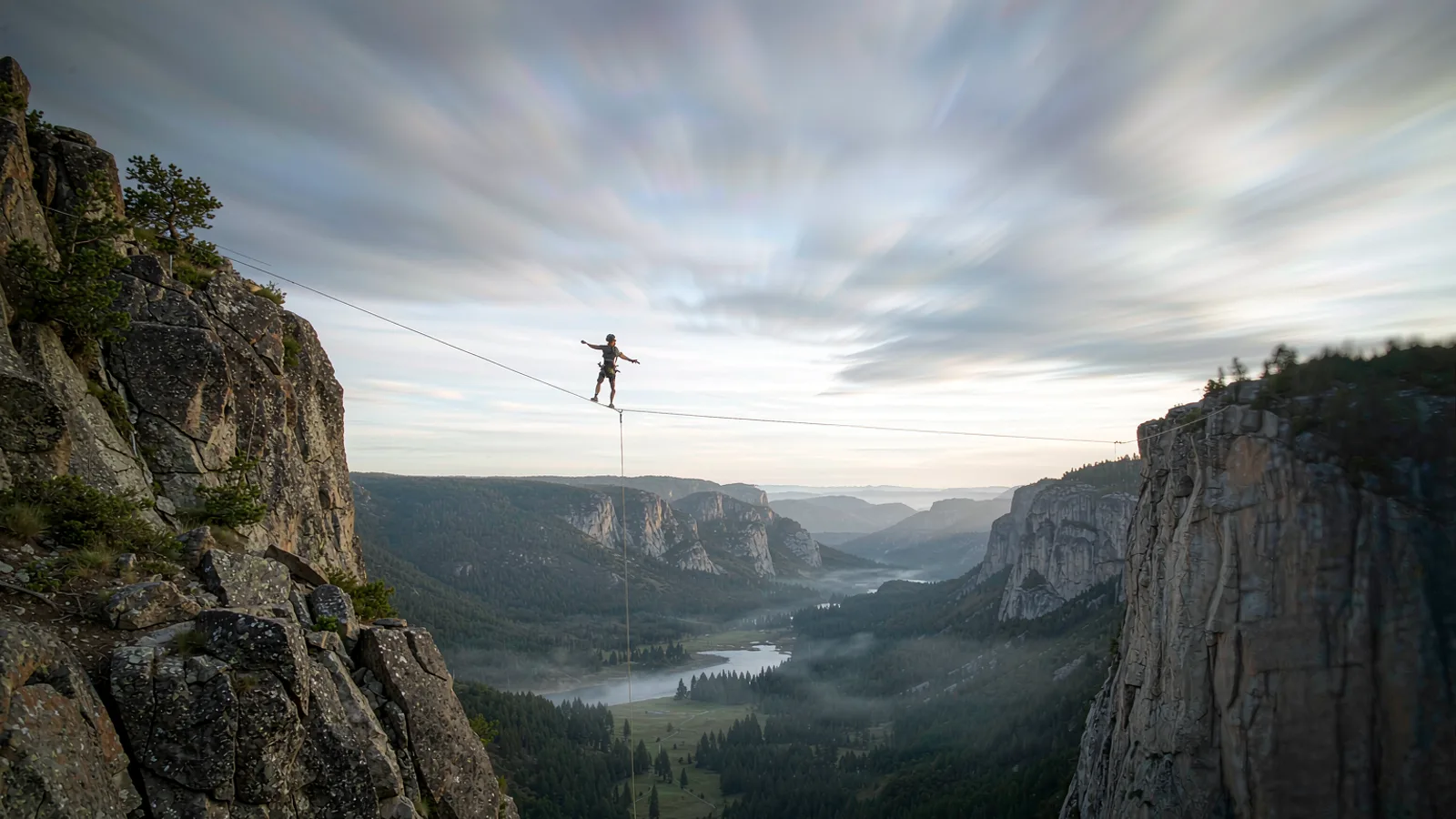
The cover illustrates the activity, not an approved rigging diagram. Progress in highlining includes understanding the boundaries of one’s knowledge and working within a properly managed system. It is not a scheduled move from a month of ground practice to an arbitrary cliff span.
Reader questions
Why can tightening a highline increase forces?
In a simplified static model, supporting a load at a shallower line angle can require greater line tension. Real systems add stretch and dynamic loading. That relationship explains why tighter is not automatically safer; it does not prescribe a rigging tension.
Does a backup line make a highline redundant automatically?
No. The design must consider component suitability, connections, failure interactions and loaded clearance. Rescue is a separate requirement. Specialist instruction and assessment of the complete system are necessary; counting components does not validate the arrangement.
Sources and scope
Each reference supports the topic stated in its scope note. Worked examples are illustrative unless identified as measured results. Use current local information and the manual for your own equipment alongside appropriate practical instruction.
- International Slackline Association: safety resourcesHighline safety standards, resources and incident-reporting information.
- ISA: webbing lifetime and freestyle warningsMaterial-dependent lifespan and the importance of redundancy.
- ISA: important points for highliningSpecialist overview of highline system suitability, backups and clearance concerns; not a complete rigging standard or construction guide.
Continue reading
- Outdoor Bouldering Technique: Footwork and Body Position
Understand outdoor bouldering footwork, edging, smearing and body position. Connect movement choices with landing, top-out and descent assessment.
- Mountain Layering System: Base, Midlayer and Shell
Plan clothing for ascent, stops and the return. Use a downloadable layering field log and a fictional worked record to separate garment, fit and packing problems.
- Bouldering Landing Zones: Crash Pads and Spotting
Assess outdoor bouldering landing zones, crash-pad gaps, changing fall directions, spotting limits and the descent before choosing a problem.