
Ski Sidecut Radius, Rocker and Effective Edge Explained
Understand ski sidecut radius, camber, rocker and effective edge. Compare specification views and learn why a stated radius does not fix the size of each turn.
By ActionSportsHQ Editorial · Published · 7 min read
At a glance
- A stated sidecut radius describes ski geometry; the skier's actual path is a separate outcome.
- Read a ski's length, width dimensions, radius and side profile together at the exact size being compared.
- Effective-edge entries require a measurement convention; the edge engaged with snow changes during use.
Ski sidecut radius describes the top-view edge curve. Camber and rocker describe the side profile along the ski. Effective edge is a length that needs the manufacturer’s measurement definition; the edge engaged with snow changes during use. These terms answer different questions, and the printed sidecut radius does not fix every turn’s radius.
Compare the exact ski length, width dimensions, radius format and profile drawing together. The diagrams and original circle calculation below show what each entry establishes and which information is still missing from a specification-only comparison.
Read the top-view shape before the radius label
The sidecut is the outline that makes many skis narrower around the waist than toward the tip and tail. A radius label describes that curve using a circular or other manufacturer-defined representation. Paradise Skis explains the circle analogy and publishes different width and radius entries across its sizes. 1
Keep the distinction between a shape description and a path. A circle drawn beside a ski represents a geometric comparison. A track in snow also involves the ski’s deformation, orientation, contact and movement. A printed “16 m” is therefore not a command that every turn must follow a 16 m circle.
Some designs use multiple curvatures. Völkl’s 3D Radius Sidecut description identifies different radii through sections of a ski rather than treating the entire edge as one circular arc. 2 When a specification contains several radii, preserve their order and the associated size instead of choosing the smallest number as the whole ski’s identity.
A circle example explains why curvature matters
A circular segment can be described by its chord, the straight distance between two endpoints, and its sagitta, the greatest gap between that chord and the arc. These are general geometric terms. The following numbers are invented to illustrate the mathematics, not taken from a ski.
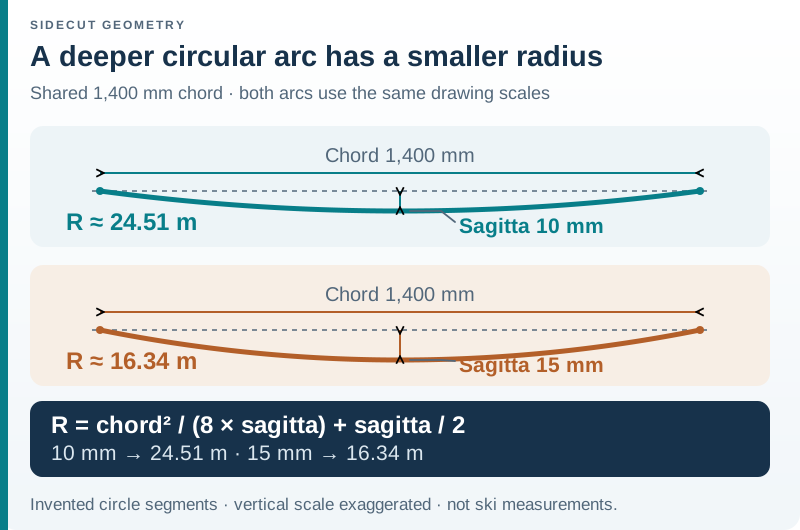
For an exact circular arc, let chord length be c, sagitta be s and radius be R. A right triangle through the circle centre gives (R − s)² + (c/2)² = R². Rearranging produces R = c²/(8s) + s/2. This is a derivation for the constructed circle, not a formula for reconstructing every ski from three published widths.
| Fictional arc | Chord c | Sagitta s | Calculated circle radius |
|---|---|---|---|
| Shallower curve | 1,400 mm | 10 mm | 24,505 mm ≈ 24.51 m |
| Deeper curve | 1,400 mm | 15 mm | 16,340.8 mm ≈ 16.34 m |
Holding the endpoints’ separation fixed while deepening the arc produces a smaller radius. That is the useful geometric conclusion. The calculation says nothing about a skier’s speed, technique, edge angle or snow conditions because none appears in it.
It also exposes missing information in a width-only comparison. The difference between tip and waist widths is not automatically this sagitta: the widest points can lie at different longitudinal positions, the tail can have another width and the edge may not follow one circle. Copy the maker’s stated radius and curve description rather than reverse-engineering a definitive number from incomplete fields.
Camber and rocker belong to a side view
Rotate the drawing mentally by a quarter turn: now inspect the ski along its length. Camber describes an arched middle in the unloaded profile; rocker describes an early rising profile toward an end or across a longer section. Both features can occur on one ski. Völkl illustrates full rocker, tip rocker and tip-and-tail rocker with camber in the middle. 2
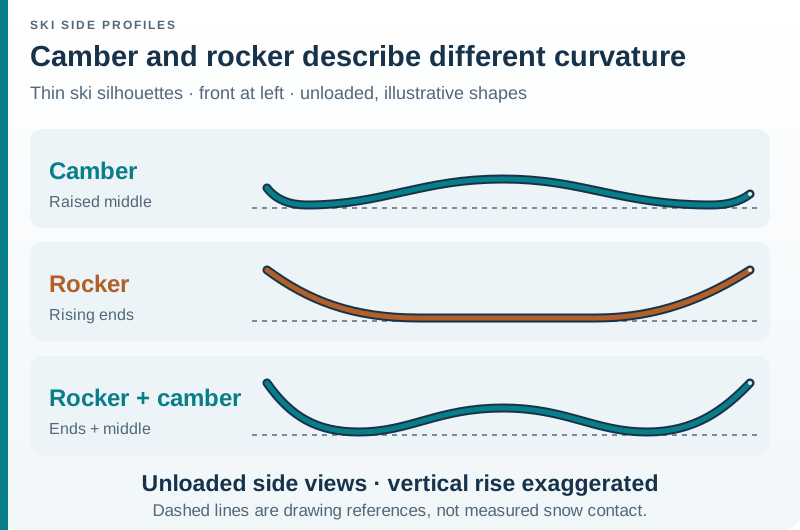
A percentage needs a definition. It could describe the longitudinal portion assigned to an end profile under that maker’s convention; it should not be read as the percentage of the ski that never contacts snow. Keep the diagram, the model size and any explanation of how the percentage is determined.
For comparison notes, write the actual words supplied: “tip rocker with camber,” for example, is more informative than ticking a yes/no rocker box. A simple box would make a tip-only profile and a full-rocker profile look identical.
Separate listed effective edge from edge engagement
A manufacturer may list effective edge as a length in its specification. Before comparing two such entries, identify what endpoints and measurement conditions the maker uses. Contact on a flat reference surface, a designed edge span and the edge engaged during a turn are different possible questions.
Völkl describes edge engagement changing as a ski is put on edge. 2 The practical implication for chart reading is that an unloaded profile drawing cannot give the engaged edge length for every moment of skiing. Loading, ski deformation and snow interaction are absent from that drawing.
Keep two separate fields in your notes: published effective-edge definition and value, and what remains unknown about the intended use. If the first field is missing, do not fill it with the ski’s overall length. If the definition differs between brands, retain both descriptions rather than presenting the numbers as a controlled comparison.
Compare the exact length, not just the model name
Use the row for the size actually under discussion. Paradise’s specification example changes radius and other dimensions across its lengths, demonstrating why one model name is not one set of numbers. 1
Here is a fictional comparison record for two candidate specifications. It describes the questions to resolve, not a purchase ranking:
| Field | Candidate A | Candidate B | Interpretation |
|---|---|---|---|
| Listed length | 176 cm | 176 cm | Matching nominal length |
| Waist width | 88 mm | 88 mm | One matching width |
| Radius entry | Single 16 m value | Three stated radii | Different shape descriptions; obtain the full curve notes |
| Side profile | Tip rocker and camber | Tip-and-tail rocker and camber | Different profile descriptions |
| Effective edge | Value supplied, definition missing | Not supplied | An edge-length comparison is unresolved |
A claim that these skis are equivalent because length and waist match drops three rows of information. A claim that one must make tighter turns drops the movement and snow context as well. The better next question is which design features a provider considers relevant to the terrain and skiing task being discussed.
Build a short specification note for a lesson or rental discussion
Keep model, generation, length, width dimensions, radius format and side-profile drawing together. Add whether the ski is being considered for a particular lesson, a rental comparison or a different type of outing. That describes the actual decision without pretending the table alone chooses the equipment.
The freeride ski guide discusses width and variable snow in the wider skiing task. For uphill equipment, ski touring versus skimo separates access systems from the descent, while climbing-skin sizing connects the ski’s full outline with coverage and attachment questions. Clothing during movement and waiting belongs in a separate layering record.
When observations are available, describe them with their context: which ski and length, which conditions and which exercise. “This ski wanted to turn more” is a starting impression. It becomes a more useful discussion when the record preserves the equipment and task, while leaving the cause open until there is evidence to distinguish it.
Sources checked 3 November 2026. Circle calculations, comparison records and vector diagrams are original editorial examples; no ski was field-tested for this article.
Reader questions
Are the tip-waist-tail numbers the sidecut radius?
No. They are width measurements at named parts of the ski, commonly in millimetres. Radius is a geometric description commonly given in metres. Widths alone omit the distances and curve between those measurement points.
Can I copy a radius from another length of the same ski?
Check the exact size row. A manufacturer can change widths and radius across the length range. A model name does not establish that every size has the same geometry.
Does a 16 m sidecut radius mean every turn has a 16 m radius?
No. The printed value describes ski geometry. The actual path also involves deformation, edge orientation, movement and snow interaction. Read the stated radius at the exact ski length as a design specification, not a fixed turn size.
Sources and scope
Each reference supports the topic stated in its scope note. Worked examples are illustrative unless identified as measured results. Use current local information and the manual for your own equipment alongside appropriate practical instruction.
- Paradise Skis: ski sidecut and radiusManufacturer explanation of sidecut shape and size-dependent specification tables; its simplified radius formula is not used here.
- Völkl: sidecut radii and rocker profilesManufacturer examples of multi-radius sidecuts, camber/rocker profile combinations and changing edge engagement.
Continue reading
- Freeride Skiing: Powder Skis and Variable Snow
Understand freeride skiing through ski width, rocker and changing snow. Compare equipment trade-offs and check what off-piste management actually covers.
- Ski Touring vs Skimo: Skins, Gear and Transitions
Compare ski touring, ski mountaineering and skimo racing. Understand climbing skins, boot and binding modes, and how to organise a transition.
- Mountain Layering System: Base, Midlayer and Shell
Plan clothing for ascent, stops and the return. Use a downloadable layering field log and a fictional worked record to separate garment, fit and packing problems.
- Ski Skin Sizing: Width, Length, Trimming and Compatibility
Size climbing skins for your exact ski: compare width, length, edge exposure and tip-tail attachments, then confirm compatibility before trimming or ordering.